
PHA in Korean Skincare: The Gentle Exfoliant for Sensitive Skin
In this article
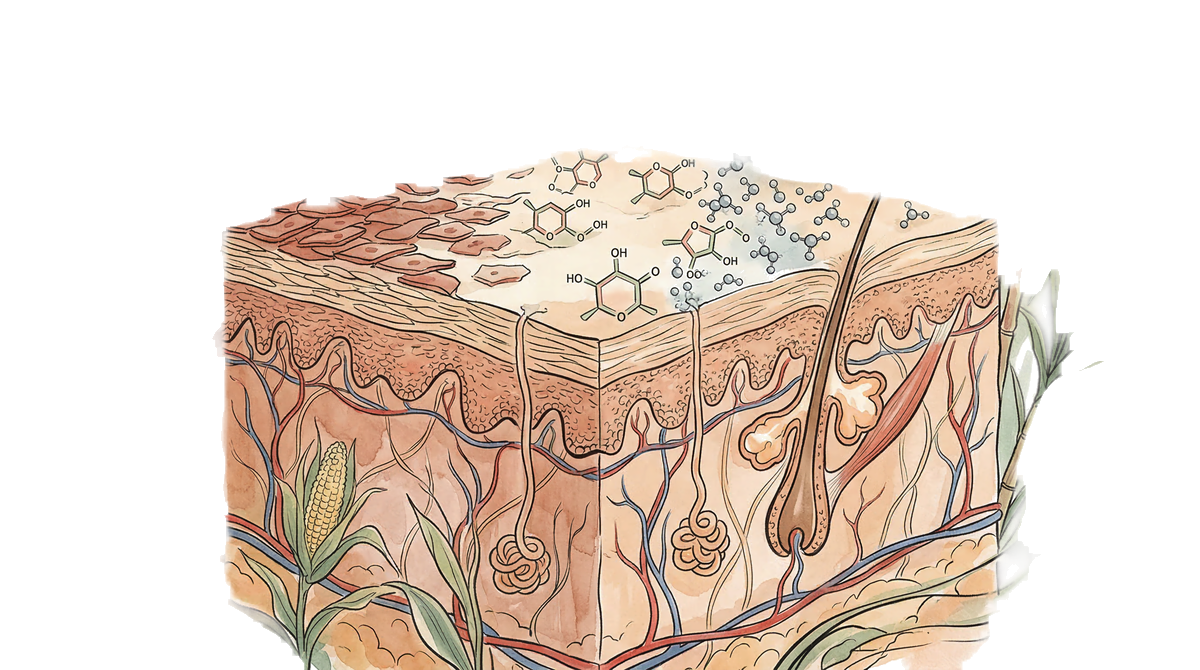
If glycolic acid stings your skin, the problem is not the exfoliation: it is the molecule size. Glycolic acid weighs 76 Da. It hits the stratum corneum fast and hard. PHAs are bigger: gluconolactone is 178 Da, lactobionic acid is 358 Da. Larger molecules penetrate more slowly, which means the exfoliation is distributed more evenly and your nerve endings have less to complain about. Edison et al. (2004) ran a 12-week head-to-head trial: 8% gluconolactone versus 8% glycolic acid. Both produced equivalent improvements in fine lines and texture. The gluconolactone group had 50% fewer reports of stinging and burning. Same result, lower price in irritation. PHAs also have a structural bonus: multiple hydroxyl groups on each molecule pull water into the stratum corneum while the exfoliation happens, so you are getting hydration alongside the resurfacing.
The bigger the acid molecule, the gentler the exfoliation. PHAs are the biggest.
Larger molecules mean slower, gentler penetration
Gluconolactone (178 Da) and lactobionic acid (358 Da) penetrate the stratum corneum 2-3x more slowly than glycolic acid (76 Da). Slower penetration means more even exfoliation and less localized irritation.
Multiple hydroxyl groups act as built-in humectants
PHAs have 3-4 hydroxyl groups per molecule compared to glycolic acid's one. These extra OH groups pull water into the stratum corneum, so PHAs hydrate as they exfoliate.
No increased photosensitivity in clinical testing
Unlike AHAs, PHAs did not increase minimal erythema dose (MED) in UV exposure studies. You still need sunscreen, but PHAs do not thin the stratum corneum enough to measurably increase UV sensitivity.
Myth: PHAs are just weaker AHAs that don't really work.
Reality: PHAs produce equivalent clinical improvements in fine lines, texture, and roughness compared to AHAs at the same concentration (Edison et al., 2004). They are not weaker. They work through the same mechanism (breaking corneocyte bonds) but penetrate more slowly due to their larger molecular size. The clinical outcomes are the same; the irritation profile is significantly better.
Clinical benefits
Equivalent exfoliation with less irritation
A 12-week randomized study compared 8% gluconolactone cream to 8% glycolic acid cream in 40 subjects. Both groups showed statistically equivalent improvements in fine lines (-23% vs. -26%), roughness, and hyperpigmentation. The gluconolactone group reported 50% fewer instances of stinging, burning, and irritation.
Edison et al., 2004 — Cutis
No measurable increase in photosensitivity
Unlike AHAs, which increase UV sensitivity by 13-18% (measured by minimal erythema dose), PHAs showed no statistically significant change in MED in controlled UV exposure testing. The stratum corneum thinning from PHAs is insufficient to alter UV transmission.
Grimes et al., 2004 — Cutis
Hydrates while exfoliating
Gluconolactone increased stratum corneum hydration by 34% over 8 weeks in a 30-subject study, measured by corneometry. This is comparable to a 5% glycerin solution. The dual exfoliation-hydration mechanism comes from the 4 hydroxyl groups per gluconolactone molecule that attract and bind water.
Tasic-Kostov et al., 2010 — International Journal of Cosmetic Science
Products with pha
Paid links: Koracle may earn from qualifying purchases. Details.
Skin types
If you have tried glycolic or lactic acid and come away with stinging, redness, or peeling, PHAs are the right swap. Your skin still gets exfoliation; it just gets it more slowly. Rosacea-prone skin tolerates PHAs well in clinical testing. Dry skin gets exfoliation and hydration in the same step. Oily skin can use PHAs but may find the effect too mild for heavy congestion: at 3-5%, you are doing maintenance, not clearing blockages. Combination skin gets balanced exfoliation without stripping the dry zones.
Effective concentrations
Gentle enough for twice-daily use. Common in toners and essences.
The concentration range used in published studies. Results comparable to 8% glycolic acid for texture and fine lines.
Used in dermatology offices. Not common in OTC K-beauty products.
Pairs well with
Ceramides
PHAs remove dead cells while ceramides rebuild the lipid barrier underneath. This combination exfoliates without compromising barrier integrity.
Niacinamide
Niacinamide strengthens the barrier and reduces redness. Pairing with PHAs gives you exfoliation with built-in irritation management.
Hyaluronic Acid
HA pulls water into the newly exfoliated stratum corneum. PHAs already hydrate somewhat, but HA amplifies the moisture retention.
Avoid combining with
AHAs (glycolic acid, lactic acid)
Using both PHA and AHA in the same routine is redundant. Both dissolve corneocyte bonds through the same mechanism. Combining them increases irritation risk without proportional benefit.
High-concentration retinol (1%+)
Both PHAs and retinol thin the stratum corneum. Combining high-strength versions of each can compromise the barrier. Low-concentration retinol (0.3-0.5%) with PHA is generally tolerated.
The bottom line
PHAs deliver real exfoliation with less irritation than AHAs. They are not weaker versions of glycolic acid. They are a different tool: slower-penetrating, less photosensitizing, and hydrating. If your skin reacts to glycolic or lactic acid with redness, stinging, or peeling, PHAs give you a way to exfoliate without those side effects. They are particularly useful for rosacea-prone skin and for people using retinoids who want gentle exfoliation on off-nights.
Common questions
Can I use PHAs every day?
At 3-5% concentration, yes. PHAs at this range are gentle enough for twice-daily use. At 8-12%, start with every other day and increase to daily if your skin tolerates it without redness or flaking.
Do PHAs require sunscreen?
PHAs do not increase photosensitivity in clinical testing, unlike AHAs. However, any exfoliation exposes newer skin cells to the surface, and you should wear sunscreen regardless of which acids you use.
What is the difference between gluconolactone and lactobionic acid?
Gluconolactone (178 Da) penetrates faster and exfoliates more actively. Lactobionic acid (358 Da) is even larger and gentler, with stronger chelating properties that neutralize free iron on the skin surface. For acne-prone skin, gluconolactone is usually the better choice. For post-procedure or rosacea-prone skin, lactobionic acid is preferred.
Find products with PHA matched to your skin.