
Beta-Carotene in Skincare: Benefits & Uses
In this article
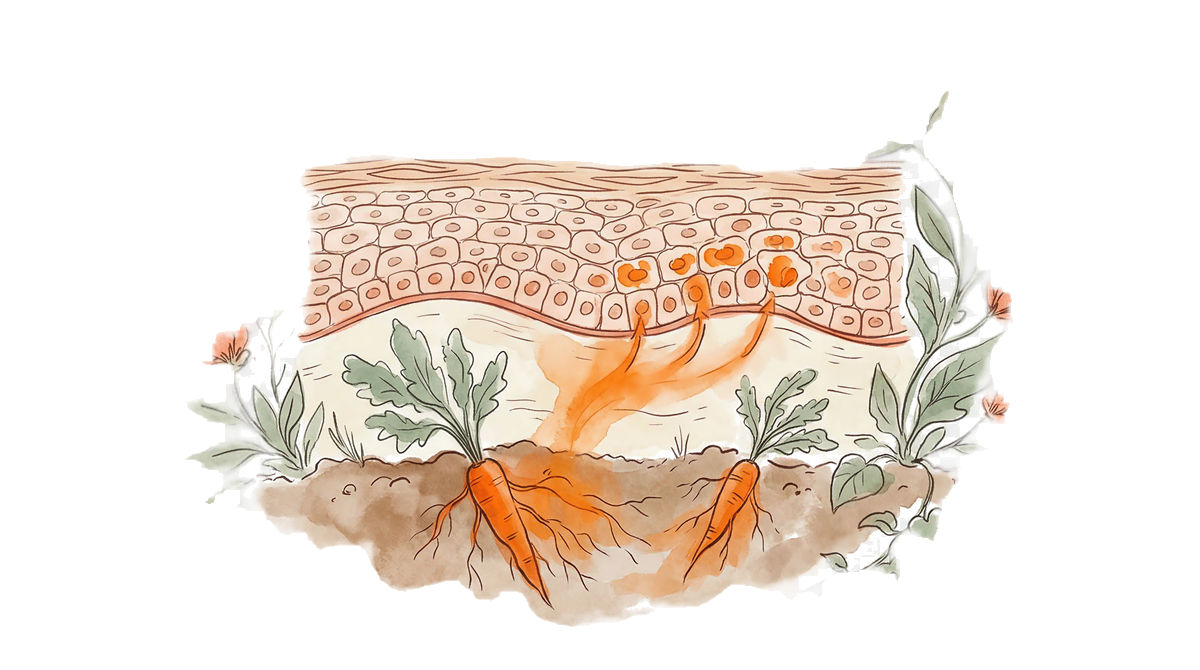
Beta-carotene is the orange pigment that makes carrots orange and sea buckthorn red. Your skin puts it to work in two ways. First: it quenches singlet oxygen, a reactive oxygen species that UV radiation generates and that degrades collagen and damages cell membranes. Second: your keratinocytes convert it to retinol via an enzyme called BCMO1. That conversion is slow and self-regulating: when your cells have enough retinol, they downregulate BCMO1 and the conversion stops. No irritation spikes, no purging. Stahl & Sies (2012) showed that daily beta-carotene use raised the minimal erythema dose by 20-30% over 10 weeks. That is a meaningful increase in UV tolerance, not a replacement for sunscreen, but a real biological layer of defense that sunscreen cannot provide.
The same pigment that makes carrots orange protects your skin from UV damage.
Quenches singlet oxygen, the primary ROS from UVA exposure
Beta-carotene's conjugated polyene chain absorbs energy from singlet oxygen and dissipates it as heat. One molecule of beta-carotene can quench approximately 1,000 singlet oxygen molecules before being degraded.
Converts to retinol via BCMO1 enzyme in keratinocytes
The conversion is slow (12:1 ratio by weight) and self-regulating: high retinol levels downregulate BCMO1 expression. This prevents the irritation spikes that direct retinol application can cause.
Raises UV tolerance by 20-30% with consistent daily use
This photoprotective effect requires 10+ weeks of daily application to build up. It supplements sunscreen but does not replace it. The protection comes from beta-carotene accumulating in the stratum corneum and epidermis.
Myth: Beta-carotene can replace sunscreen because it protects against UV damage.
Reality: Beta-carotene raises the minimal erythema dose by 20-30%, which is meaningful but nowhere near the protection of SPF 30 (which blocks 97% of UVB). Beta-carotene adds a layer of antioxidant defense that helps neutralize the UV damage sunscreen misses. It is a supplement to sunscreen, not a substitute.
Clinical benefits
Photoprotection through singlet oxygen quenching
A meta-analysis of 7 controlled studies found that beta-carotene supplementation (topical and/or oral) increased the minimal erythema dose by a mean of 25% after 10-12 weeks of daily use. The protection was additive with sunscreen, not overlapping.
Stahl & Sies, 2012 — Molecular Nutrition & Food Research
Slow-release retinoid activity
Topical beta-carotene provides sustained, low-level retinol delivery through enzymatic conversion in keratinocytes. A study of carrot seed oil application (rich in beta-carotene) showed increased epidermal retinol levels after 4 weeks without the irritation, peeling, or erythema seen with direct retinol at comparable retinoid activity levels.
Darvin et al., 2008 — Journal of Biomedical Optics
Antioxidant protection for lipid membranes
As a lipid-soluble molecule, beta-carotene integrates into cell membranes where it scavenges peroxyl radicals and prevents lipid peroxidation chain reactions. This is particularly relevant in the epidermis, where UV-generated free radicals cause cumulative membrane damage.
Baumann, Cosmetic Dermatology Ch. 34 — Antioxidants
Products with beta-carotene
Paid links: Koracle may earn from qualifying purchases. Details.
Skin types
All skin types can use beta-carotene. If your skin is sensitive or reacts to retinol, the self-regulating conversion mechanism is exactly what you want: you get retinoid activity without the irritation spike. Dry skin works well with the typical oil-based carriers beta-carotene is formulated in. Oily skin can use water-dispersible versions without the heaviness. One note for fair skin: at higher concentrations (0.5%+), beta-carotene can deposit enough pigment in your stratum corneum to impart a faint orange tint. It is harmless and reverses within a few weeks of stopping. At typical product concentrations (0.01-0.1%), it is not a concern.
Effective concentrations
Common in serums and moisturizers as part of an antioxidant blend. Provides free radical scavenging without visible color.
Higher concentrations found in carrot seed oil-based products. May impart a slight orange tint to very fair skin.
Pairs well with
Vitamin C
Vitamin C regenerates oxidized beta-carotene, extending its antioxidant lifespan. Both protect against UV damage through different mechanisms (singlet oxygen quenching vs. electron donation).
Vitamin E
The classic antioxidant triad: vitamins C + E + beta-carotene protect at different points in the oxidative chain. Beta-carotene handles singlet oxygen, vitamin E handles peroxyl radicals in membranes, vitamin C recycles both.
Squalane
Squalane is a lipid-soluble carrier that improves beta-carotene's distribution across the skin surface. Both integrate into cell membranes where UV damage occurs.
Avoid combining with
Direct retinol (at high concentrations)
Beta-carotene converts to retinol in the skin. Adding direct retinol on top can cause retinoid excess in sensitive individuals. At low retinol concentrations (0.3%), the combination is generally tolerated.
The bottom line
Beta-carotene is a mild antioxidant and a slow-release retinol precursor. It provides measurable photoprotection (20-30% increase in MED) and gentle retinoid activity without irritation. It is not a substitute for sunscreen or for direct retinol if you need aggressive anti-aging. Its best use case is as a supporting antioxidant in a broader routine, particularly for sun-exposed skin that needs extra oxidative defense. K-beauty products deliver it through carrot seed oil, sea buckthorn, and carotenoid-rich botanical extracts.
Common questions
Will beta-carotene turn my skin orange?
At the concentrations used in skincare (0.01-0.5%), this is unlikely for most skin tones. Very high oral intake or very high topical concentrations on very fair skin can cause carotenodermia, a harmless and reversible yellowing. It resolves within weeks of stopping use.
Is topical beta-carotene better than oral supplementation?
Both deliver beta-carotene to the skin, but through different routes. Topical application concentrates it in the stratum corneum and epidermis. Oral supplementation distributes it systemically. The photoprotective studies used both routes. For targeted skin benefits, topical is more direct.
Can I use beta-carotene during the day?
Yes. Beta-carotene is photostable in formulation and its antioxidant activity is specifically targeted at UV-generated free radicals. Daytime use is the most logical application timing. Always use it under sunscreen.
Find products with Beta-Carotene matched to your skin.