
Salicylic Acid (BHA) for Acne-Prone Skin
In this article
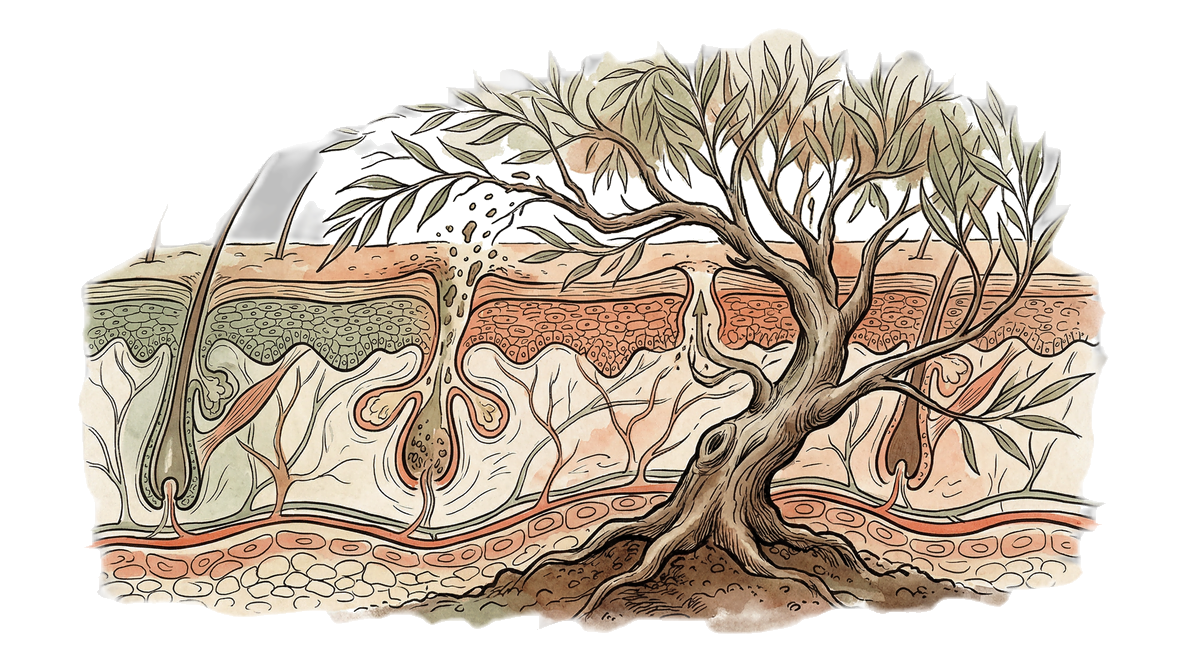
Salicylic acid is the only common exfoliant that can get inside your pores. AHAs are water-soluble: they exfoliate your surface and stop there. BHA is oil-soluble. It dissolves into the sebum lining your pore walls and breaks apart the keratin plug from the inside. That's why dermatologists reach for it first for blackheads, whiteheads, and oily-skin acne. Baumann adds another dimension: salicylic acid suppresses proinflammatory genes by inhibiting NF-kappaB, AP-1, and C/EBP-beta DNA-binding activities. That's not just exfoliation: it's anti-inflammatory action at the gene transcription level, through the same arachidonic acid cascade that aspirin targets.
Every exfoliant scrubs the surface. Only one dissolves into oil and works from inside the pore.
The only common exfoliant that gets inside a pore
AHAs are water-soluble and stop at the surface. BHA is oil-soluble. It dissolves into the sebum lining the pore wall and breaks apart the keratin plug from the inside out.
Anti-inflammatory through the same pathway as aspirin
Salicylic acid inhibits cyclooxygenase and suppresses NF-kB, AP-1, and C/EBP-beta at the gene transcription level. Red, inflamed papules flatten faster with BHA than with AHA exfoliants because of this dual action.
42% comedone reduction at 2% over 12 weeks
Split-face trial data. The comedolytic effect comes from dissolving keratin bonds inside the follicle, a different mechanism than physical scrubs or surface-level acids.
Myth: BHA is too harsh for daily use
Reality: At 0.5-1%, BHA is well-tolerated daily by most oily and combination skin types after a 2-week introduction. The clinical trials showing irritation used 2% or higher. K-beauty BHA products with betaine salicylate release acid slowly, reducing peak irritation. The real risk is stacking BHA with retinol or AHA in the same step: that's over-exfoliation from the combination, not from BHA itself.
Clinical benefits
Comedone reduction and pore clearing
A 12-week split-face trial in 30 subjects with mild-to-moderate acne found that 2% salicylic acid reduced comedone counts by 42% versus vehicle control. The comedolytic effect comes from dissolving keratin bonds inside the follicle, which is a different mechanism than physical scrubs or AHAs that only exfoliate the surface.
Zander & Weisman, 1992 — Journal of the American Academy of Dermatology
Inflammatory acne reduction
A randomized, investigator-blinded trial of 180 patients comparing 2% salicylic acid pads to 10% benzoyl peroxide cream found that salicylic acid reduced inflammatory lesions by 43% at 12 weeks with significantly fewer side effects (dryness, peeling, burning). For mild-to-moderate inflammatory acne, BHA is an effective first-line treatment with better tolerability than benzoyl peroxide.
Shalita, 1989 — International Journal of Dermatology
Surface exfoliation and texture smoothing
Daily use of 1.5% salicylic acid reduced skin roughness scores by 28% over 12 weeks in a photodamaged skin population. BHA loosens corneocyte adhesion on the skin surface in addition to its pore-clearing action. The result is smoother texture and more even light reflection, which reduces the visible appearance of pore openings.
Grimes et al., 2004 — Cutis
Anti-inflammatory activity
Salicylic acid inhibits cyclooxygenase (COX) enzymes, reducing prostaglandin E2 production in keratinocytes. This mechanism is why inflamed, red papules flatten faster with BHA than with AHA exfoliants. The anti-inflammatory effect is concentration-dependent and measurable at 0.5% and above.
Arif, 2015 — Journal of Clinical and Aesthetic Dermatology
Products with salicylic acid
Paid links: Koracle may earn from qualifying purchases. Details.
Skin types
If your skin is oily or combination, BHA has a clear advantage over water-soluble AHAs: it needs oil-filled pores to show what it can do. If your skin is dry with occasional blackheads, a low-concentration BHA (0.5%) applied only to your T-zone avoids over-drying the rest of your face. If your skin is sensitive, start at 0.5% and limit yourself to twice weekly. K-beauty BHA products often buffer the acid with centella or panthenol, which makes them noticeably easier on reactive skin.
Effective concentrations
Safe for twice-weekly use while your skin builds tolerance. K-beauty products often use betaine salicylate at 4% to deliver roughly this level of free acid activity.
Standard concentration in K-beauty BHA toners and essences. Good for ongoing blackhead prevention in oily and combination skin.
Matches the concentration in most clinical acne trials. Best used 3-4 times per week rather than daily for long-term use. Every-other-day is safer for most people.
Pairs well with
Niacinamide
Niacinamide reduces the excess sebum that BHA clears out. The combination targets acne from both sides: BHA unblocks existing clogs, niacinamide reduces oil production so new clogs form slower. Apply BHA first (lower pH), wait 5-10 minutes, then niacinamide.
Centella asiatica
Centella calms the inflammation and redness that BHA can trigger on sensitive skin. Many K-beauty BHA toners include centella extract in the formula for exactly this reason. The anti-inflammatory effects of both ingredients stack without interfering with BHA's exfoliation.
Avoid combining with
Retinol (same routine step)
Both BHA and retinol exfoliate. Applying them simultaneously strips the barrier faster than it regenerates, causing redness, peeling, and increased sensitivity. Use BHA in the morning or on alternate nights from retinol. Once your skin is adapted to each ingredient individually, you can experiment with both in one evening, but start them separately.
AHA (same routine step)
Stacking BHA and AHA doubles the exfoliation load. This is unnecessary for most people and increases the risk of over-exfoliation, barrier damage, and rebound oil production. If you want both, alternate nights. Some products combine low doses of each (0.5% BHA + 1% AHA), which is gentler than using full-strength versions of both.
The bottom line
BHA at 1-2% is the first-line OTC treatment for blackheads and oily-skin acne. Its advantage over AHAs is oil solubility: it reaches inside the pore where comedones form. Baumann notes that salicylic acid at concentrations up to 30% can treat age-related pigmented spots, reduce surface roughness, and diminish fine lines, though K-beauty products stay in the 0.5-2% range. Start at 0.5% twice weekly, build up. Don't stack it with retinol in the same routine step. If you're using a K-beauty BHA with betaine salicylate, know that 4% betaine salicylate delivers roughly 0.5-1% free acid activity.
Common questions
What does betaine salicylate mean, and how does it compare to salicylic acid?
Betaine salicylate is a compound where salicylic acid is bonded to betaine, an amino acid derivative. It releases free salicylic acid slowly after application, resulting in less initial irritation and lower peak concentration on the skin. A product with 4% betaine salicylate delivers roughly the same free acid activity as 0.5-1% pure salicylic acid over time. K-beauty brands like COSRX use betaine salicylate to work within Korean cosmetic regulations that cap salicylic acid at 0.5%.
Can I use BHA every day, or should I alternate days?
It depends on the concentration and your skin's tolerance. At 0.5%, daily use is fine for most oily and combination skin types after a 2-week introduction period. At 2%, every other day or 3-4 times per week is safer for long-term use. Signs of over-exfoliation include persistent tightness, shiny-but-dry texture, increased redness, and more breakouts than before you started. If any of those appear, reduce frequency and repair the barrier with ceramides before resuming.
Why does my skin get oilier after starting BHA?
Two possible reasons. First, if you are over-exfoliating, the damaged barrier signals sebaceous glands to produce more oil as a protective response. Cut back frequency and see if oil levels normalize after a week. Second, BHA clears out compacted sebum plugs in the first few weeks, which can temporarily increase visible oil on the surface as trapped sebum is released. This settles by week 3-4. If oiliness persists past 6 weeks, the product may be too strong for your skin.
Does BHA work on blackheads specifically?
Blackheads (open comedones) are BHA's strongest use case. The dark color of a blackhead comes from oxidized sebum and melanin in an open, impacted pore. BHA dissolves the sebum plug from the inside because it is oil-soluble. AHAs and physical exfoliants cannot reach inside the pore the same way. Consistent use at 1-2% for 6-8 weeks typically reduces visible blackheads on the nose and chin. BHA does not shrink the pore itself, but empty pores appear smaller because the dark plug is gone.
Is salicylic acid safe during pregnancy?
Oral salicylates are contraindicated during pregnancy due to aspirin-related risks. For topical salicylic acid, the data is limited. The American College of Obstetricians and Gynecologists considers low-concentration topical BHA (under 2%) applied to small areas as low-risk, but many dermatologists recommend avoiding it as a precaution, especially in the first trimester. Azelaic acid at 15-20% is the preferred pregnancy-safe alternative for acne, or glycolic acid (AHA) for surface exfoliation. Consult your OB-GYN for personalized guidance.
Find products with Salicylic Acid (BHA) matched to your skin.