
Retinol in Korean Skincare: Benefits, Studies, and How to Use It
In this article
Retinol has more published research behind it than any other anti-aging ingredient you can buy without a prescription. It thickens your dermis, blocks the enzymes that chew up collagen after UV exposure, and accelerates cell turnover so damaged skin is replaced faster. The catch is the adjustment period (peeling, redness, dryness) that makes most people quit in the first two weeks. K-beauty figured this out years ago: low-concentration formulas, the sandwich method, ceramide-heavy routines. You can get the results without the misery. The ingredient works. Whether you stick with it long enough to see that comes down to how you introduce it.
The most studied anti-aging ingredient you can buy without a prescription. The catch is the first two weeks.
20x gentler than tretinoin, same cellular result
At 0.25%, unoccluded retinol induces similar molecular changes to 0.025% prescription retinoic acid. The slower conversion rate means less irritation for the same gene activation.
Blocks the enzymes that UV uses to eat collagen
Tretinoin inhibits all three MMPs (collagenase, gelatinase, and stromelysin) that UV exposure activates to degrade dermal collagen. Retinol does the same thing, just slower.
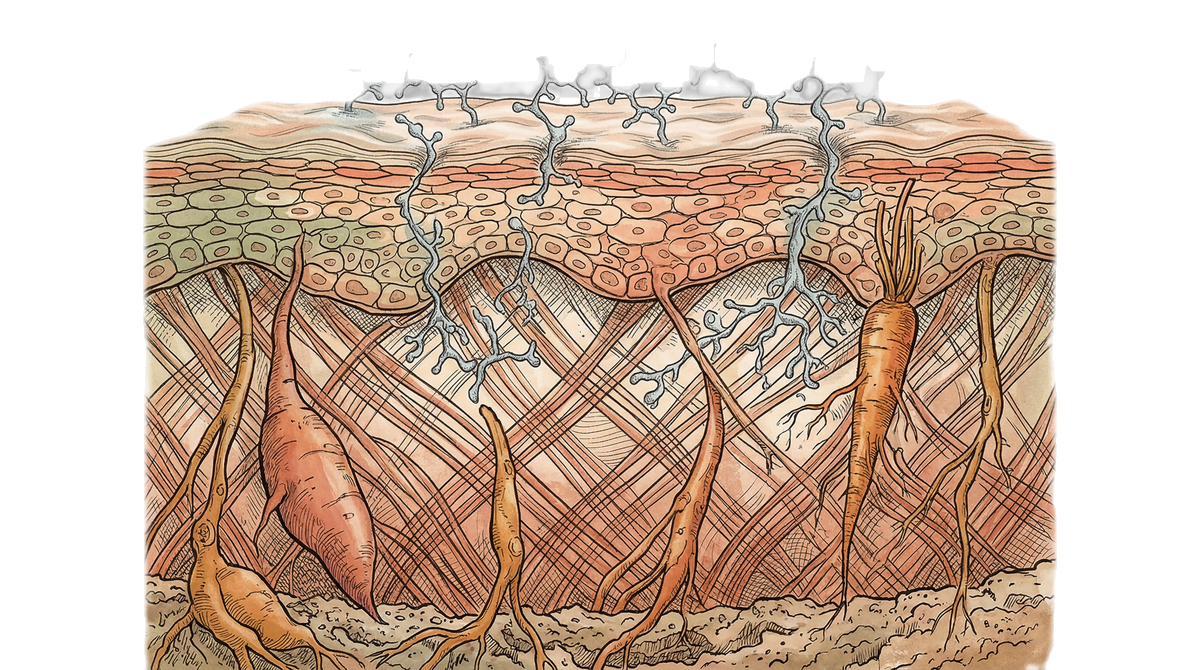
Thickens your dermis while thinning dead surface cells
Retinol speeds turnover of the stratum corneum (dead cell layer) while increasing cell proliferation and firmer-looking skin support in deeper layers. The net effect is denser, firmer skin with a smoother surface.
Myth: Retinol thins your skin over time
Reality: Retinol thins the stratum corneum (the dead cell layer on the surface) by shedding it faster. But it thickens the living epidermis and dermis by increasing cell proliferation and firmer-looking skin support. Long-term studies confirm the net effect is structurally thicker, denser skin with a thinner, more even surface layer.
Clinical benefits
Wrinkle reduction
A 24-week randomized, double-blind, vehicle-controlled trial in 36 elderly subjects found that topical retinol produced statistically significant improvements in fine wrinkles. Biopsies confirmed increased glycosaminoglycan and procollagen I expression in retinol-treated skin versus vehicle.
Kafi et al., 2007 — Archives of Dermatology
Photoaging reversal
A review of clinical evidence found that retinoids reverse multiple signs of photoaging: rough texture, mottled pigmentation, fine lines, and sallowness. Retinol at 0.1-1% was effective in multiple controlled trials, though at slower onset than prescription tretinoin. Improvements were sustained with continued use over 6-12 months.
Gorouhi et al., 2009 — Dermatologic Therapy
Acne treatment
Retinoids normalize follicular keratinization, preventing the microcomedone formation that starts the acne cascade. A multicenter trial confirmed that over-the-counter retinol formulations reduced non-inflammatory acne lesions over 12 weeks, though less effectively than prescription adapalene. Retinol is a reasonable option for mild comedonal acne when prescription access is limited.
Leyden et al., 2017 — Journal of Drugs in Dermatology
Skin texture and tone
Accelerated cell turnover replaces sun-damaged keratinocytes faster, reducing rough patches and mottled pigmentation. A 12-week study found measurable improvements in skin smoothness and evenness at 0.1% retinol applied three times weekly. The effect compounds with consistent long-term use.
Kang et al., 2005 — Journal of Investigative Dermatology
Products with retinol
Paid links: Koracle may earn from qualifying purchases. Details.
Skin types
If your skin runs oily or combination, you'll tolerate retinol more easily: your sebum levels buffer irritation naturally. If you have dry or sensitive skin, you can still use it, but start at 0.025% and use the sandwich method (moisturizer under and over the retinol) to manage dryness and flaking.
Effective concentrations
For beginners and sensitive skin. Use every third night for the first 4 weeks, then increase frequency.
After 8-12 weeks of tolerating the starter dose without persistent irritation. Most people get strong results here.
For experienced users only. Retinaldehyde (retinal) at similar concentrations converts faster with more irritation potential.
Pairs well with
Ceramides
Retinoids increase cell proliferation, which decreases ceramide biosynthesis short-term, partly explaining the dryness and flaking during the adjustment period (Baumann, Ch. 30). A ceramide moisturizer applied before or after retinol directly replenishes those lipids. Baumann recommends mixing a pea-size amount of retinoid with a pea-size amount of moisturizer for first-time users.
Hyaluronic acid
Pulls water into the stratum corneum to counteract the drying effect of retinol-driven cell turnover. Applying HA on damp skin before retinol keeps the skin hydrated through the adjustment phase.
Niacinamide
Niacinamide increases ceramide production and reduces inflammation, directly counteracting the two main side effects of retinol. Using niacinamide in the morning routine while retinol goes in the PM is a well-documented pairing in K-beauty protocols.
Avoid combining with
BHA (salicylic acid) at the same time
Both are exfoliating. Applying BHA and retinol in the same routine step strips the barrier faster than it can repair, causing redness, peeling, and increased sensitivity. Use them on alternate nights, or BHA in the AM and retinol in the PM if your skin tolerates both.
Benzoyl peroxide
Benzoyl peroxide oxidizes retinol on contact, deactivating it before it can absorb. If you need both for acne, apply benzoyl peroxide in the morning and retinol at night. Do not layer them.
The bottom line
Retinol works, but patience is the price of admission. Start at 0.025% every third night, increase over months, and pair with ceramides and niacinamide to manage the adjustment period. At 0.25%, unoccluded retinol induces similar cellular changes to prescription tretinoin at 0.025%, without the irritation (Baumann, Ch. 30). Results sustain at three times weekly after the initial 48-week buildup, but they reverse if you stop entirely for 24 weeks. Retinyl palmitate, despite showing up in hundreds of products, is topically ineffective. Look for retinol or retinaldehyde on the label.
Common questions
What is the sandwich method for retinol, and does it reduce effectiveness?
Apply a thin layer of moisturizer, wait a minute, apply retinol, then apply another layer of moisturizer on top. This buffers the retinol's contact with skin and reduces irritation. A clinical study found that retinol applied over moisturizer still produced statistically significant wrinkle improvement versus vehicle at 24 weeks. The sandwich method slows absorption slightly but does not cancel the effect.
Why does retinol cause peeling and how long does it last?
Retinol accelerates keratinocyte turnover from the normal 28-day cycle to roughly 14-21 days. The skin sheds surface cells faster than it is used to, which shows up as flaking and peeling. This adjustment period (sometimes called retinization) typically lasts 2-6 weeks. If peeling persists past 8 weeks, the concentration is likely too high or the frequency too aggressive for your skin.
Can I use retinol in the summer or only in winter?
You can use retinol year-round as long as you apply SPF 30+ every morning. Retinol does increase photosensitivity because the thinner, newer skin cells reaching the surface are more vulnerable to UV damage. The risk is from skipping sunscreen, not from the season itself. Dermatologists do not recommend pausing retinol seasonally.
What is the difference between retinol, retinal, and tretinoin?
All three are forms of vitamin A that convert to retinoic acid in the skin. Retinol requires two enzymatic conversions (retinol to retinal to retinoic acid), so it is the gentlest and slowest-acting. Retinal (retinaldehyde) needs only one conversion step, making it faster-acting with a bit more irritation potential. Tretinoin is retinoic acid itself, available by prescription only, and produces the fastest results with the highest irritation risk. OTC K-beauty products use retinol or retinal.
How often should I apply retinol when starting out?
Twice per week for the first 4 weeks. If there is no persistent redness, flaking, or stinging at that frequency, increase to three times per week for the next 4 weeks. Gradual increases over 3-4 months can bring you to nightly use if your skin tolerates it. Jumping straight to nightly application is the most common cause of retinol irritation and abandonment.
Does retinol thin the skin over time?
No. This is a common misconception. Retinol thins the stratum corneum (the dead cell layer on the surface) by shedding it faster, which is why skin looks smoother. But it thickens the epidermis and dermis by increasing cell proliferation and firmer-looking skin support. The net effect is structurally thicker, denser skin with a thinner, more even surface layer. Long-term studies confirm this.
Find products with Retinol (Vitamin A) matched to your skin.