
Chaga Mushroom in Skincare: What It Does
In this article
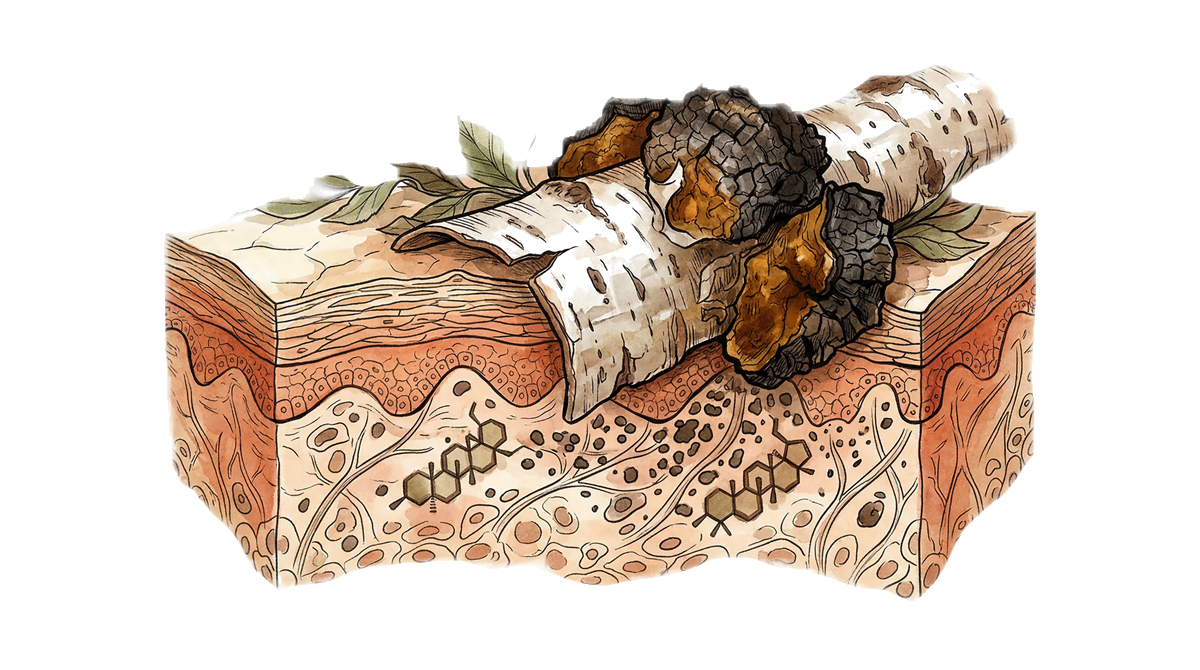
If you've been buying into the mushroom skincare wave, chaga is probably already in your cabinet. The ORAC score (over 100,000 units per gram) gets quoted constantly, as if a high antioxidant number in a test tube guarantees results on your face. It doesn't quite work that way. Chaga (Inonotus obliquus), a parasitic fungus that grows on birch trees across Korea, Siberia, and northern Canada, delivers real antioxidant activity through betulinic acid derivatives and fungal melanin. But both are large molecules with limited skin penetration. What you're getting topically is genuine surface-level free radical scavenging, not the transformative anti-aging punch the marketing implies. The clinical data for topical chaga is sparse: most evidence is in vitro or from oral supplementation studies, not from applying it to skin.
A birch tree parasite with the highest antioxidant score in nature. But does that translate to your skin?
Betulinic acid inhibits NF-kB inflammatory signaling in cell models
Betulinic acid, derived from the birch bark the fungus colonizes, shows dose-dependent anti-inflammatory activity in keratinocyte studies. Concentrations above 10 micromolar suppressed IL-6 and TNF-alpha production.
Fungal melanin absorbs UV radiation across a broad spectrum
Chaga produces its own melanin as a defense against UV exposure on birch bark. This melanin absorbs UV-A and UV-B wavelengths, though the photoprotective effect on skin has only been demonstrated in vitro.
Contains over 200 bioactive compounds including polysaccharides and triterpenoids
The extract is chemically complex. Beta-glucans, inotodiol, and lanosterol contribute to the immunomodulatory and antioxidant profile. The challenge is that most of these compounds are too large for stratum corneum penetration.
Myth: Chaga has 1,000 times more antioxidants than blueberries, so it must be the best anti-aging ingredient.
Reality: ORAC scores measure antioxidant capacity in a test tube, not on living skin. The large molecular size of chaga's key compounds limits penetration through the stratum corneum. High ORAC does not equal high topical efficacy. Proven topical antioxidants like L-ascorbic acid (vitamin C) have far more clinical evidence despite lower ORAC scores.
Clinical benefits
Broad-spectrum antioxidant activity
Chaga extract showed 34% DPPH free radical scavenging activity at 100 micrograms per milliliter in a comparative study of medicinal mushrooms. The activity was attributed primarily to the polyphenol and melanin fractions rather than individual compounds.
Cui et al., 2005, Journal of Ethnopharmacology
Anti-inflammatory through NF-kB suppression
Inotodiol, a lanostane triterpenoid isolated from chaga, inhibited NF-kB activation and reduced production of nitric oxide and prostaglandin E2 in lipopolysaccharide-stimulated macrophages at concentrations of 10-50 micromolar.
Ma et al., 2013, International Immunopharmacology
UV-protective melanin content
The melanin pigment complex extracted from chaga showed broad-spectrum UV absorption (200-600nm range) and protected human keratinocytes from UVB-induced DNA damage in cell culture at 50 micrograms per milliliter.
Zheng et al., 2011, Food Chemistry
Products with chaga mushroom extract
Paid links: Koracle may earn from qualifying purchases. Details.
Skin types
Every skin type can use chaga extract without specific concerns. If your skin is dry or sensitive, you'll get the most benefit: the anti-inflammatory properties provide genuine calming support. If your skin runs oily, there's no issue: the extract is water-soluble and non-comedogenic, so it won't conggest your pores. No contact dermatitis from topical chaga has been reported in the dermatological literature, though the limited usage history means it's a track record of absence rather than proven safety.
Effective concentrations
Typical concentration in K-beauty serums and creams. Provides surface-level free radical scavenging.
Higher concentrations found in mushroom-focused products. May darken product color due to melanin content.
Pairs well with
Vitamin C
Chaga's melanin-based antioxidant activity complements vitamin C's ascorbate pathway. Different mechanisms of free radical neutralization provide broader coverage.
Hyaluronic acid
Chaga provides antioxidant protection while hyaluronic acid handles hydration. No interaction conflicts between the two.
Centella asiatica
Both target inflammation through different pathways. Centella works through TGF-beta modulation while chaga works through NF-kB suppression.
Avoid combining with
No known conflicts
Chaga extract has no documented negative interactions with common skincare actives. Its neutral pH and water-soluble nature make it compatible with most formulations.
The bottom line
Chaga is a legitimate antioxidant source with a long ethnobotanical track record. Its betulinic acid shows anti-inflammatory activity in cell studies, and the fungal melanin provides some UV-protective properties. But topical skincare evidence is limited to in vitro work. If you see chaga in a K-beauty product, it is a reasonable supporting ingredient alongside proven actives like vitamin C or niacinamide. It should not be your primary antioxidant defense.
Common questions
Is chaga mushroom good for anti-aging skincare?
Chaga provides antioxidant protection that may slow oxidative damage to skin, but there are no clinical trials demonstrating anti-aging results from topical chaga application. The in vitro antioxidant data is strong. The clinical translation is unproven. Use it as a supporting ingredient alongside retinol or vitamin C, not as a standalone anti-aging treatment.
Can chaga mushroom help with sensitive or redness-prone skin?
The anti-inflammatory compounds in chaga (betulinic acid, inotodiol) reduce inflammatory markers in cell studies. Anecdotal reports from K-beauty users describe calming effects, but no controlled clinical trials have measured redness reduction from topical chaga in human subjects.
What is the difference between chaga extract and reishi in skincare?
Both are medicinal mushrooms with antioxidant properties, but their active compound profiles differ. Chaga is higher in betulinic acid and melanin. Reishi (Ganoderma lucidum) is richer in ganoderic acids and beta-glucans. Reishi has slightly more topical skincare research, particularly for skin recovery.
Find products with Chaga Mushroom Extract matched to your skin.