
Vitamin C Myths: Does It Really Oxidize in Sunlight?

In this article
You've probably heard it a hundred times: don't use vitamin C in the morning, it oxidizes in sunlight. Store the bottle in the fridge. Apply it at night so it doesn't break down on your face. The advice is everywhere, and most of it is wrong.
Vitamin C does oxidize. But the conditions that cause it to break down inside a well-formulated serum are not the same conditions you encounter when you step outside with it on your skin.
TL;DR
L-ascorbic acid oxidizes in the bottle, not on your face. Once it's absorbed into your skin, sunlight doesn't meaningfully degrade it — in fact, that's when it does its best work. Use it in the morning under sunscreen. Toss the bottle when it turns dark orange.
The myth: Vitamin C oxidizes in sunlight, so you should only use it at night.
The reality: L-ascorbic acid oxidizes in the bottle when exposed to air, water, and heat over time. Once absorbed into your skin, sunlight doesn't meaningfully degrade it — in fact, neutralizing UV-induced free radicals is exactly what it's there to do.
What "oxidation" actually means
Oxidation is a chemical reaction where vitamin C donates electrons and converts into dehydroascorbic acid, then into inactive breakdown products like 2,3-diketogulonic acid. The reaction is driven by four things: oxygen exposure, water, elevated pH, and catalytic metals like iron and copper (Pinnell, 2003).
Light is on the list, but it's far down. In Sheldon Pinnell's foundational work on topical L-ascorbic acid, the primary stability threats were pH above 3.5 and prolonged air exposure. UV light was a minor contributor compared to dissolved oxygen in the formula.
The myth conflates two different scenarios. A serum sitting in a clear bottle on a sunny windowsill for three months will oxidize. Your serum absorbed into your stratum corneum and worn outside for an hour will not — at least not in any way that matters.
What happens when you wear it in sunlight
The oxidation isn't the failure mode. It's the function.
Here's the part that flips the myth on its head. Vitamin C's job on your skin is to neutralize reactive oxygen species generated by UV exposure. It was designed, evolutionarily and formulationally, to get used up by sunlight.
A landmark study by Lin et al. (2003) applied 15% L-ascorbic acid plus 1% alpha-tocopherol to pig skin, then irradiated it with UVB. The treated skin showed a fourfold reduction in thymine dimers — a marker of UV-induced DNA damage — compared to untreated controls. The vitamin C got oxidized. That's the point.
Applying vitamin C and then hiding from the sun is like buying a seatbelt and refusing to drive. The oxidation isn't the failure mode. It's the function.
Wondering if vitamin C fits your routine?
Answer 9 questions. Koracle checks fit, conflicts, texture, and evidence.
Build my routine →Where the myth comes from
The confusion traces back to bottle stability, not skin stability. L-ascorbic acid at the concentrations used in serums (10-20%) at a pH around 3.0-3.5 is genuinely unstable in water. Studies on formulation shelf life show measurable degradation within weeks if the product is exposed to air and light repeatedly (Austria et al., 1997).
That real stability problem got translated, somewhere along the way, into "don't wear it in the sun." The translation lost the part about timescales. A serum sitting open for a month is a different situation than a serum on your face for 30 minutes.
Dark glass bottles, airless pumps, and refrigeration all address the bottle problem. None of them address an imaginary problem on your skin.
How to actually use it
Apply L-ascorbic acid in the morning on clean, dry skin, before moisturizer and sunscreen. The combination of vitamin C plus broad-spectrum SPF provides more photoprotection than either alone (Darr et al., 1996). This is the standard protocol in dermatology, not a contrarian take.
Paid links: Koracle may earn from qualifying purchases. Details.
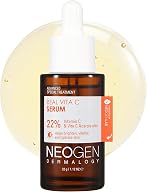
View on Amazon. Amazon shows final price and availability.
Store the bottle away from direct sun and heat. A bathroom cabinet is fine. A windowsill is not. If your serum turns from clear or pale straw-yellow to deep orange or brown, replace it. The L-ascorbic acid has oxidized into erythrulose and related compounds — at that point it's closer to a self-tanner than an antioxidant.
If you want more forgiveness on storage, use a derivative. Sodium ascorbyl phosphate and 3-O-ethyl ascorbic acid are stable at neutral pH, don't require airless packaging, and convert to ascorbic acid in the skin. The tradeoff is slower onset and weaker clinical evidence than pure L-ascorbic acid, but the stability advantage is real.
The bottom line
Vitamin C oxidizes in the bottle, not on your face. Morning use under sunscreen is the protocol with the strongest evidence behind it, and the oxidation that happens as it quenches UV-induced free radicals is exactly what you're paying for. Watch the color of the bottle, not the weather.
Related: Niacinamide — What It Does for Pigmentation · Alpha-Arbutin — Brightening Without the Irritation · Tranexamic Acid — The Brightener with Clinical Backing · Oily + Brightening Routine · Hyperpigmentation + Oily Routine
Common Questions
Should I only use vitamin C at night?↓
No. Morning application is actually backed by the strongest evidence. Vitamin C works alongside sunscreen to neutralize free radicals generated by UV exposure, which is its most useful job.
How can I tell if my vitamin C has oxidized?↓
L-ascorbic acid turns from clear or pale yellow to deep orange or brown as it oxidizes. A slight yellow tint is fine. Dark amber means it's lost most of its potency and you should replace it.
Do vitamin C derivatives oxidize the same way?↓
No. Derivatives like sodium ascorbyl phosphate (SAP) and magnesium ascorbyl phosphate (MAP) are far more stable than L-ascorbic acid and don't oxidize meaningfully with light exposure in well-formulated products.
Turn what you learned into a routine that fits your skin.
Answer a few questions and Koracle will check formula fit, budget, tolerance, and routine order.
Build my formula-checked routine