
Hydrocolloid Patches in K-Beauty: How Wound Dressing Technology Treats Acne
In this article
That little round sticker on your nightstand table isn't skincare. It's a wound dressing. The material (carboxymethylcellulose suspended in a polyurethane matrix) was developed for surgical wounds, burns, and chronic ulcers. Korean brands, led by COSRX with their Acne Pimple Master Patch in 2014, realized that the same moist skin recovery science behind hospital wound care works on your pimples. Your skin recovers 35-40% faster in a moist environment than a dry one. The patch seals the lesion, pulls out the fluid, and keeps your fingers off it. That last point matters more than most people expect: the mechanical barrier stops you from reintroducing bacteria and interrupts compulsive picking before it happens.
A surgical wound dressing became K-beauty's most practical acne product. Here is why it actually works.
Absorbs 2-3 times its weight in wound exudate
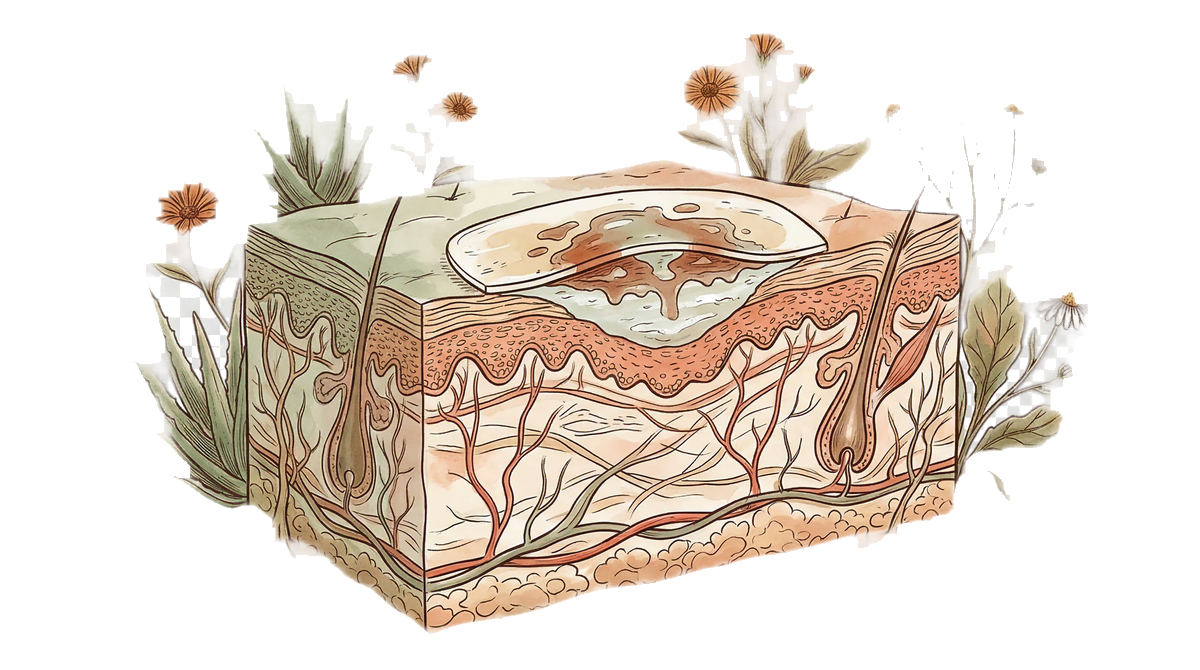
Carboxymethylcellulose (CMC) particles in the patch swell as they absorb fluid, forming a gel. This gel traps bacteria and cellular debris, pulling them away from the wound bed. The white swelling you see on a used patch is CMC gel saturated with exudate.
Maintains moist wound environment that speeds recovery by 35-40%
George Winter's landmark 1962 Nature study demonstrated that wounds heal faster in a moist environment than when left to dry and scab. The hydrocolloid creates a sealed microenvironment with controlled moisture, oxygen, and pH that promotes keratinocyte migration across the wound surface.
Physical barrier prevents bacterial reintroduction and compulsive picking
The polyurethane outer layer is waterproof and bacterially occlusive. It physically separates the lesion from fingers, pillowcases, and environmental contaminants. For acne patients with skin-picking behavior, this mechanical barrier is the single most effective intervention.
Myth: Hydrocolloid patches 'draw out' acne from deep within the skin.
Reality: Hydrocolloid patches absorb fluid from the surface of open lesions through capillary action. They cannot extract material from closed comedones, cystic nodules, or intact pustules. The white swelling on a used patch is absorbed exudate from the wound surface, not acne being 'pulled out' from deep in the pore. If the lesion is not open and draining, the patch is just an expensive sticker.
Clinical benefits
Accelerated skin recovery through moist environment
Winter's foundational 1962 study in Nature demonstrated that wounds covered with an occlusive dressing re-epithelialized 35-40% faster than air-exposed wounds. Subsequent meta-analyses of chronic wound care confirmed the principle. The mechanism is that epidermal cells migrate more efficiently across a moist wound bed than through dehydrated, crusted tissue.
Winter, 1962, Nature
Reduced post-inflammatory hyperpigmentation (PIH)
A retrospective analysis of acne scar outcomes found that occlusive moist skin recovery reduced PIH incidence by 68% compared to standard dry recovery. The reduction was attributed to less inflammation from crust formation and reduced melanocyte stimulation from UV exposure of the recovery wound.
Wikramanayake et al., 2022, Journal of Drugs in Dermatology
Mechanical barrier against picking and external contamination
A behavioral study of 120 acne patients found that applying physical barriers to active lesions reduced skin-picking episodes by 74% over 4 weeks. The hydrocolloid patch both removes visual cues (covering the lesion) and creates a tactile barrier that interrupts the picking reflex.
Schut et al., 2015, Acta Dermato-Venereologica
Skin types
Hydrocolloid patches work on every skin type. If you're oily or acne-prone, you'll get the most use out of them: open lesions are where they shine. If your skin is sensitive, the CMC gel is biocompatible and non-irritating, so no issues there. If you're dry, watch for mild peeling around the adhesive edges after extended wear (8+ hours), as the adhesive can occasionally cause irritation in people with polyisobutylene sensitivity. None of these are reasons to avoid patches; they're just things to know.
Effective concentrations
Thin patches for daytime use under makeup. Lower absorption capacity but less visible.
Overnight patches with higher absorption capacity. Some include salicylic acid or tea tree oil in the adhesive layer for additional antibacterial effect.
Pairs well with
Salicylic acid (BHA)
Apply salicylic acid before placing the patch to help dissolve residual sebum in the pore. The patch then seals the treatment in place and prevents it from rubbing off on a pillowcase.
Centella asiatica
CICA-infused patches combine hydrocolloid absorption with centella's wound-recovery triterpenoids. The occlusive environment increases centella penetration into the lesion.
Niacinamide
Post-patch application of niacinamide helps prevent post-inflammatory hyperpigmentation by inhibiting melanosome transfer in the newly healed tissue.
Avoid combining with
Retinoids (on the patch site)
Retinoids thin the epidermis and can increase irritation under an occlusive patch. Apply retinoids to the rest of the face and skip the active lesion area covered by the hydrocolloid.
Benzoyl peroxide (under the patch)
Benzoyl peroxide can degrade the adhesive and cause excessive drying of the wound bed. If using both, apply benzoyl peroxide first, let it absorb for 15 minutes, then apply the patch.
The bottom line
Hydrocolloid patches work because they apply established skin recovery science to acne lesions. The moist wound environment accelerates re-epithelialization by 35-40% compared to letting a pimple dry out and scab. They absorb exudate, protect the wound from external bacteria and fingers, and reduce post-inflammatory hyperpigmentation risk by preventing crust formation. They do not treat closed comedones, cystic acne, or acne that has not been extracted. Use them on open, draining lesions only.
Common questions
Should I pop a pimple before applying a hydrocolloid patch?
Hydrocolloid patches work best on open, draining lesions. If a pimple has a visible white head, gentle extraction followed by a patch will produce the best results. On closed comedones or cystic acne without a head, the patch has no fluid to absorb and provides only a physical barrier against picking. Dermatologists recommend against forceful extraction, which damages surrounding tissue.
How long should I leave a hydrocolloid patch on?
6-12 hours is optimal. The patch is saturated when it turns white and opaque from absorbed exudate. Leaving a saturated patch on beyond this point reduces its effectiveness since the CMC gel is at maximum absorption. If the patch is still clear after 8 hours, the lesion was not actively draining and may not benefit from hydrocolloid treatment.
Can I use hydrocolloid patches on cystic acne?
Standard hydrocolloid patches have minimal effect on cystic acne because cystic lesions are deep (in the dermis), not open, and do not drain fluid to the surface. Microneedle patches with dissolving tips that deliver salicylic acid or hyaluronic acid into deeper layers may reach cystic lesions, but these are a different product category from standard hydrocolloid patches.
Find products with Hydrocolloid matched to your skin.