
Fermented Soybean in K-Beauty: Brightening
In this article
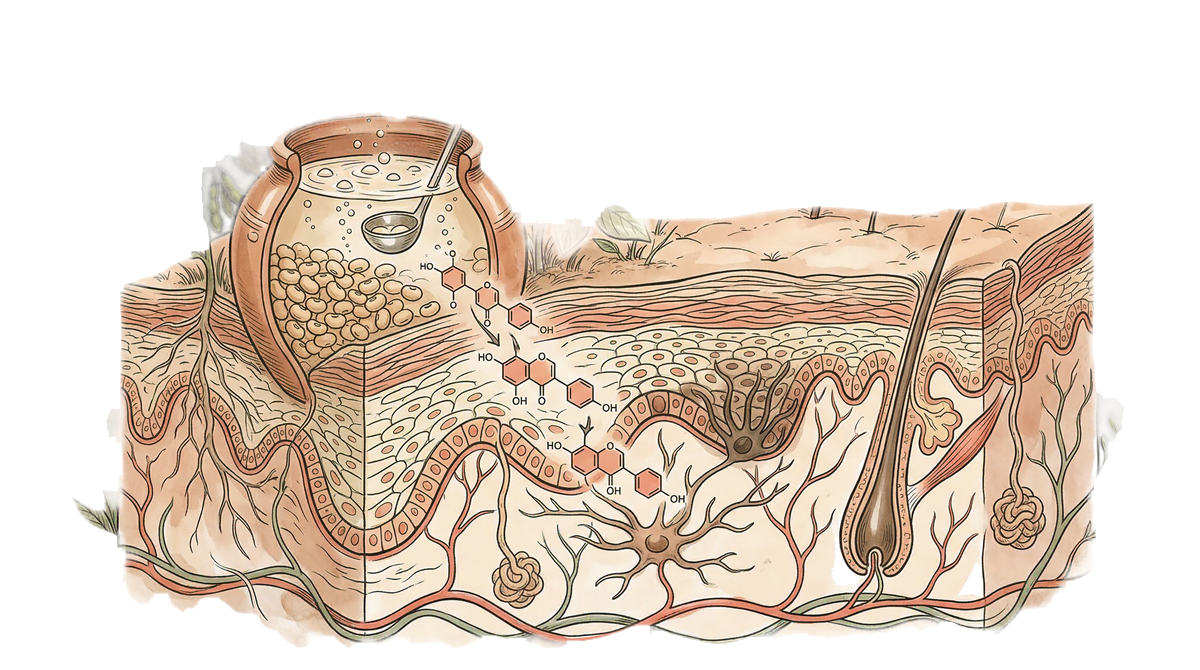
If you've used a K-beauty first essence or a doenjang-inspired fermented serum, you've already been dosing your skin with genistein. Fermentation changes soy from a mediocre skincare ingredient into a meaningful one. Unfermented soy contains isoflavones mostly as glycosides (genistin, daidzin), large molecules that penetrate your stratum corneum poorly. Fermentation with Bacillus subtilis or Aspergillus oryzae cleaves the sugar groups, converting glycosides into their aglycone forms (genistein, daidzein). Smaller, more lipophilic, and 3-5 times better at reaching your epidermis. Genistein is the star: it inhibits tyrosinase (IC50 ~52 micromolar), blocks UV-induced MMP-1 expression, and acts as a weak phytoestrogen that may support dermal collagen. Baumann's Cosmetic Dermatology (Ch. 35) cites soy as one of the few plant-derived ingredients with credible anti-aging and depigmenting data.
Doenjang and cheonggukjang taught Korean grandmothers something cosmetic chemists proved decades later.
Fermentation increases bioavailable genistein by 3-5 times
Bacterial beta-glucosidases cleave sugar groups from genistin (glycoside, MW 432 Da) to produce genistein (aglycone, MW 270 Da). The smaller, more lipophilic molecule penetrates the stratum corneum more effectively.
Genistein inhibits both tyrosinase and UV-induced collagen breakdown
A dual mechanism: genistein competes with L-DOPA for the tyrosinase active site (brightening) and blocks UV-induced MMP-1 expression in fibroblasts by 54% (anti-aging). Few ingredients address both concerns through single-compound activity.
Phytoestrogen activity supports dermal thickness without systemic hormonal effects
Genistein binds estrogen receptor beta with low affinity. Topical application delivers the compound to the dermis without significant systemic absorption, avoiding the hormonal concerns of oral phytoestrogen supplementation.
Myth: All soy-based skincare products deliver the same benefits regardless of processing.
Reality: Unfermented soy extract contains isoflavones mainly as glycosides, which are too large and too hydrophilic to penetrate the skin barrier effectively. Fermentation converts these to aglycones (3-5x better bioavailability). A product listing 'soy extract' is not equivalent to one listing 'fermented soybean extract' or 'Bacillus/soybean ferment filtrate.' Check the ingredient list.
Clinical benefits
Tyrosinase inhibition for brightening
Genistein inhibited mushroom tyrosinase with an IC50 of 52 micromolar in enzymatic assays. In a 12-week double-blind study of 65 women, a 2% soy isoflavone cream improved skin luminosity scores by 18% and reduced melanin index by 11% compared to vehicle.
Baumann, Cosmetic Dermatology Ch. 35; Wallo et al., 2007
MMP-1 suppression to protect collagen
Genistein at 10 micromolar reduced UVB-induced MMP-1 expression by 54% in cultured human dermal fibroblasts. MMP-1 (collagenase) is the primary enzyme responsible for breaking down type I collagen during photoaging.
Kang et al., 2003, Journal of Investigative Dermatology
Skin texture improvement through fermentation byproducts
A randomized trial of 40 women using a fermented soybean serum for 8 weeks showed significant improvement in skin roughness and fine line depth measured by profilometry. The effect was attributed to the combined action of isoflavones, fermentation-derived peptides, and lactic acid.
Kim et al., 2014, Journal of Cosmetic Dermatology
Skin types
Every skin type benefits from fermented soybean extract. If you're oily, the lightweight water-based format won't add congestion. If you're dry, the fermentation-derived amino acids and peptides give your skin the humectant support it needs. Sensitive skin should patch test, as some fermented products carry naturally occurring organic acids that cause mild tingling on reactive skin. And if you've worried about soy allergy, the allergenic protein fraction is largely broken down during fermentation, making topical reactions rare.
Effective concentrations
Typical in K-beauty essences and serums. Enough genistein delivery for measurable tyrosinase inhibition.
Higher concentrations found in first essences and fermented product lines. Richer in peptides and amino acids from the fermentation process.
Pairs well with
Niacinamide
Genistein blocks melanin production at the tyrosinase level; niacinamide blocks melanosome transfer to keratinocytes. Different stages of the pigmentation pathway for additive brightening.
Retinol
Retinol stimulates new firmer-looking skin support; genistein protects existing collagen from MMP-1 degradation. One builds, the other defends.
Vitamin C
Both inhibit tyrosinase but through different mechanisms (vitamin C chelates copper at the active site; genistein competes with L-DOPA). Combined, they achieve greater melanin suppression than either alone.
Avoid combining with
No known conflicts
Fermented soybean extract is chemically stable and does not interact negatively with acids, retinoids, or other actives at typical formulation concentrations.
The bottom line
Fermented soybean extract is one of the better-studied plant-derived brightening and anti-aging ingredients. The fermentation step is what makes it work: converting bulky glycoside isoflavones into their bioavailable aglycone forms. Genistein's dual action on tyrosinase (brightening) and MMP-1 (anti-aging) gives it a legitimate multi-benefit profile. It is not as potent as retinol for aging or as fast as hydroquinone for pigmentation, but it is well-tolerated, pregnancy-safe, and supported by real clinical data.
Common questions
Is fermented soybean extract safe during pregnancy?
Topical genistein from fermented soy does not achieve systemic absorption levels that would affect estrogen-sensitive conditions. Dermatologists generally consider topical soy products pregnancy-safe, unlike retinoids or hydroquinone. However, consult your doctor if you have concerns about phytoestrogen exposure.
What is the difference between 'galactomyces ferment filtrate' and fermented soybean?
Galactomyces ferment filtrate is produced by fermenting a yeast (Galactomyces, formerly Pitera) in a sugar-rich medium. Fermented soybean uses bacteria or fungi to ferment soybeans. The active compound profiles are different: galactomyces produces vitamins, amino acids, and organic acids; fermented soy produces isoflavone aglycones, peptides, and amino acids. Both are 'fermented' but the starting material and active ingredients differ.
Does fermented soybean extract smell like fermented food?
Raw fermented soybean (doenjang, natto) has a strong smell from volatile amines produced during fermentation. Cosmetic-grade fermented soybean extracts are purified and deodorized during manufacturing. Most finished products have no fermented food smell. Some first essences retain a faint yeasty note that dissipates after application.
Find products with Fermented Soybean matched to your skin.