
Camellia Oil in K-Beauty: Benefits for Skin
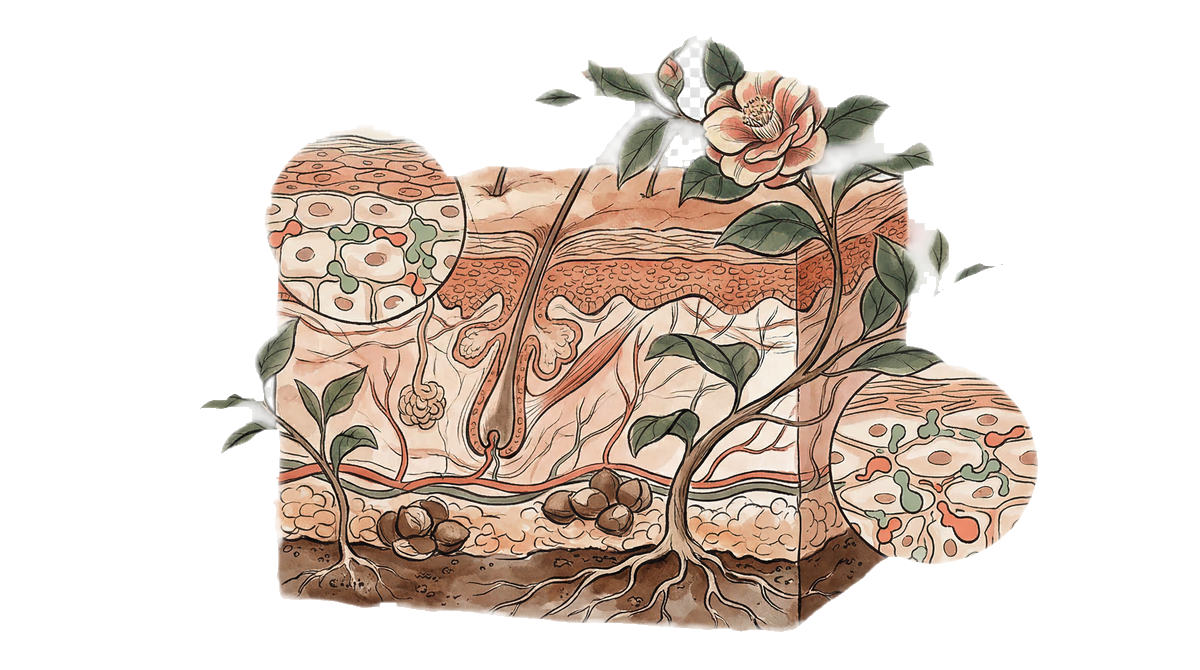
In this article
If you've ever used a K-beauty oil without feeling greasy, there's a good chance it was camellia. Called dongbaek in Korean and tsubaki in Japanese, Camellia japonica seed oil has been East Asia's beauty oil for over a thousand years, first for hair, then for skin. The reason it works is simple chemistry: 80-85% oleic acid, one of the highest concentrations of any plant oil. That monounsaturated fat integrates into your skin's own lipid matrix and absorbs faster than coconut or shea, which run heavy with saturated fats. The trade-off is worth knowing: oleic acid can disrupt your stratum corneum barrier if your skin is already compromised by eczema. For intact skin, though, it's lighter and faster-absorbing than argan or marula, which is exactly why K-beauty reaches for it at the final moisturizing step.
Geisha hair care. Jeju Island skincare. Camellia oil has been East Asia's beauty oil for a millennium.
80-85% oleic acid for fast absorption without greasiness
Oleic acid (C18:1) is a monounsaturated fatty acid that the stratum corneum absorbs readily because it matches the skin's own lipid profile. Compared to coconut oil (high in lauric acid) or shea butter (high in stearic acid), camellia oil leaves less surface residue.
Contains squalene (1-3%) plus catechins and kaempferol for antioxidant activity
Squalene is a lipid antioxidant naturally present in human sebum. The polyphenol fraction (catechins, kaempferol) provides additional free radical scavenging. These are minor components by concentration but contribute measurably to the oil's oxidative stability.
High oxidative stability means longer shelf life than most plant oils
The high monounsaturated content and low polyunsaturated content make camellia oil resistant to oxidation. It has a shelf life of 1-2 years without added antioxidants, compared to 6-12 months for rosehip or hemp seed oil.
Myth: Camellia oil and tea tree oil come from the same plant family.
Reality: They are completely unrelated. Camellia oil comes from Camellia japonica (family Theaceae, the tea plant family). Tea tree oil comes from Melaleuca alternifolia (family Myrtaceae, the myrtle family). They share the word 'tea' in common English names, but the plants, their chemistry, and their skincare functions are entirely different. Camellia oil is an emollient; tea tree oil is an antiseptic.
Clinical benefits
Emollient barrier support with fast absorption
In a comparative study of 6 plant oils, camellia oil showed the fastest absorption rate (measured by skin surface sebumeter readings returning to baseline within 30 minutes) while maintaining TEWL reduction comparable to heavier oils measured at 4 hours post-application.
Kim et al., 2012, Industrial Crops and Products
Antioxidant activity from squalene and polyphenols
Cold-pressed camellia oil showed DPPH radical scavenging activity of 42% at 1 mg/mL, attributed to the combined squalene (1-3%) and polyphenol (catechins, kaempferol) fractions. This is lower than dedicated antioxidant oils like rosehip but higher than mineral oil.
Jung et al., 2007, Food Chemistry
Anti-inflammatory activity in skin irritation models
Topical camellia oil reduced ear edema by 36% in a 12-O-tetradecanoylphorbol-13-acetate (TPA)-induced mouse inflammation model. The anti-inflammatory effect was attributed to the oleic acid fraction and kaempferol content.
Lee & Yen, 2006, Journal of Agricultural and Food Chemistry
Skin types
Dry and combination skin get the most from camellia oil's fast-absorbing emolliency. If you're oily, 2-3 drops as a final step is fine: just know your skin may not need it if sebum is already doing that job. Sensitive skin with an intact barrier tolerates it well. The one caution: if your barrier is actively compromised by eczema or a damaged stratum corneum, oleic acid can increase permeability and worsen TEWL rather than reduce it. In that case, reach for a linoleic-acid-dominant oil (safflower, evening primrose) until your barrier recovers.
Effective concentrations
Common in K-beauty creams and emulsions. Adds moisture without heaviness.
2-3 drops as a final step. Press into skin after moisturizer. Can also be used as a hair finishing oil.
Pairs well with
Hyaluronic acid
Apply hyaluronic acid first to draw water into the epidermis, then seal with camellia oil. The oil prevents the HA-attracted water from evaporating.
Niacinamide
Niacinamide strengthens the ceramide-based barrier; camellia oil fills the oleic acid gap in the lipid matrix. They address different components of barrier function.
Retinol
Camellia oil applied after retinol reduces the dryness and peeling that retinol commonly causes. The oleic acid helps buffer retinoid irritation without diluting the active.
Avoid combining with
No absolute conflicts
Camellia oil is chemically inert with other skincare actives. The only caution is for severely compromised barriers where oleic acid may increase permeability. In that case, linoleic-acid-dominant oils (like safflower or evening primrose) are gentler.
The bottom line
Camellia oil is a well-tolerated, fast-absorbing plant oil with a long track record in East Asian beauty. Its high oleic acid content provides excellent emolliency and integrates well with the skin's lipid matrix. The squalene and polyphenol content adds mild antioxidant activity. It is not a treatment oil (it will not brighten, firm, or clear acne) but a reliable final-step emollient. Avoid it if you have eczema or a compromised barrier, as oleic acid can increase transepidermal water loss in damaged skin.
Common questions
Is camellia oil comedogenic?
Camellia oil has a comedogenicity rating of 1-2 (low). Its high oleic acid content absorbs into the lipid matrix rather than sitting on the surface, which reduces pore-blocking risk. However, individual responses vary. If you are acne-prone, patch test on a small area of your jawline for 2 weeks before full-face use.
What is the difference between camellia oil and green tea oil?
Both come from the Camellia genus, but from different species. Camellia oil (from C. japonica) is a seed oil rich in oleic acid, used as an emollient. Green tea extract (from C. sinensis) is a leaf extract rich in EGCG polyphenols, used as an antioxidant. They have different chemical compositions and different skincare functions.
Can I use camellia oil on my hair?
Yes. This is its traditional use in East Asia. Camellia oil's oleic acid content smooths the cuticle layer of hair strands, reducing frizz and adding shine. Apply 1-2 drops to damp or dry hair ends. It is light enough not to weigh down fine hair. Japanese tsubaki hair products are based on this traditional application.
Find products with Camellia Oil matched to your skin.