
Bakuchiol in Korean Skincare: The Plant-Based Retinol Alternative That Actually Works
In this article
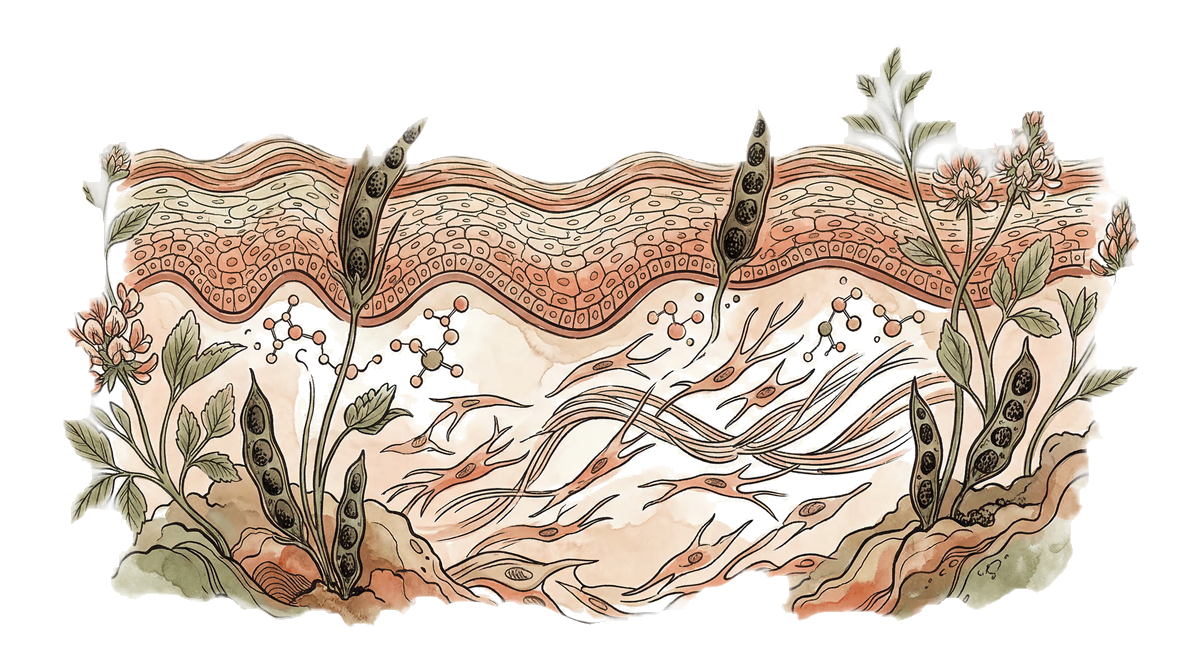
Bakuchiol is not retinol. It does not bind retinoid receptors. It is a meroterpene from the seeds of Psoralea corylifolia, a plant used in Ayurvedic and Chinese medicine for centuries. Yet it switches on the same genes retinol does: types I, III, and IV collagen, plus aquaporin 3 for hydration. In 2019, Dhaliwal et al. published a 12-week head-to-head in the British Journal of Dermatology: 0.5% bakuchiol twice daily versus 0.5% retinol once daily. Both groups showed statistically equivalent improvements in wrinkle depth and hyperpigmentation. The bakuchiol group reported zero instances of scaling or stinging. The retinol group reported both. If retinol irritates your skin or you are pregnant, this is your best available alternative, and the data to back it is real.
Same collagen genes. Different pathway. Zero peeling.
Plant-derived, not a retinoid, does not bind retinoid receptors
Bakuchiol is a meroterpene from Psoralea corylifolia seeds. It upregulates collagen and anti-aging genes through the MAPK and PI3K/Akt signaling pathways, bypassing retinoid receptors entirely.
Matched retinol for wrinkle depth and pigmentation in a 12-week RCT
Dhaliwal et al. (2019) found no statistically significant difference between 0.5% bakuchiol (2x daily) and 0.5% retinol (1x daily) for wrinkle area, hyperpigmentation, and overall photodamage after 12 weeks.
No photosensitivity, no scaling, pregnancy-compatible
Because bakuchiol does not activate retinoid receptors, it does not carry retinol's teratogenic risk or photosensitizing effect. It can be used morning and night without UV concerns.
Myth: Bakuchiol is 'natural retinol' and works the same way.
Reality: Bakuchiol is structurally and mechanistically different from retinol. Retinol binds RAR and RXR receptors in the nucleus to activate gene transcription. Bakuchiol modulates the same downstream genes (collagen I, III, IV) but through MAPK and PI3K/Akt signaling cascades. Calling it 'natural retinol' is marketing shorthand, not biochemistry. The clinical outcomes overlap, but the pathways are distinct.
Clinical benefits
Wrinkle reduction equivalent to retinol
A 12-week prospective, randomized, double-blind study compared 0.5% bakuchiol (applied twice daily) to 0.5% retinol (applied once daily) in 44 subjects. Both groups showed statistically equivalent improvements in wrinkle surface area and hyperpigmentation measured by Visia-CR analysis. No significant difference between groups at 12 weeks.
Dhaliwal et al., 2019 — British Journal of Dermatology
supports firmer-looking skin synthesis without retinoid receptor binding
In vitro studies on human dermal fibroblasts showed 0.5% bakuchiol increased type I collagen mRNA expression by 1.4-fold and type IV collagen by 1.6-fold, comparable to 0.025% retinol. The mechanism involves MAPK/ERK pathway activation rather than RAR/RXR receptor binding.
Chaudhuri & Bojanowski, 2014 — International Journal of Cosmetic Science
Anti-inflammatory and antioxidant activity
Bakuchiol reduced UVB-induced IL-6 and TNF-alpha secretion by 35-45% in human keratinocyte cultures. Its antioxidant capacity (ORAC value) is comparable to alpha-tocopherol. This dual action protects against photoaging while calming existing inflammation.
Goldstein et al., 2019 — Dermatologic Surgery
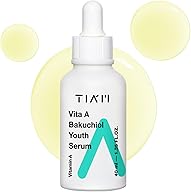
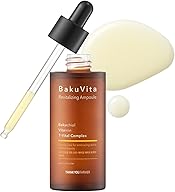
Products with bakuchiol
Paid links: Koracle may earn from qualifying purchases. Details.
Skin types
Sensitive skin is the clearest use case. You get collagen stimulation without the peeling, redness, and six-week adjustment period that retinol demands. Dry skin benefits from the aquaporin 3 upregulation, which increases cellular water transport. If you are pregnant or breastfeeding, bakuchiol is the call: no retinoid receptor binding means no teratogenic risk, and dermatologists broadly consider it safe during pregnancy. Oily skin can use bakuchiol, but if your main goal is sebum regulation, retinol has an advantage bakuchiol does not: it down-regulates sebum production. Bakuchiol does not.
Effective concentrations
The concentration used in the Dhaliwal head-to-head trial vs. retinol. Effective for wrinkles and pigmentation.
Some K-beauty serums use 1-2% for faster visible results. Well-tolerated even at these higher levels.
Pairs well with
Vitamin C
Bakuchiol's firmer-looking skin support pairs with vitamin C's role as a cofactor in collagen cross-linking. Unlike retinol, bakuchiol has no pH or stability conflict with L-ascorbic acid.
Hyaluronic Acid
Bakuchiol upregulates aquaporin 3 for cellular hydration; HA provides surface-level moisture. The two address hydration at different skin layers.
Niacinamide
Niacinamide's barrier-strengthening and brightening effects complement bakuchiol's collagen stimulation. No interaction concerns.
Avoid combining with
Retinol (in the same routine)
Using both is redundant, not dangerous. They stimulate the same downstream genes. Alternating nights is fine if you want to test which works better for your skin.
The bottom line
Bakuchiol produces real anti-aging results. The Dhaliwal trial is well-designed, and the wrinkle and pigmentation outcomes matched retinol. The advantage is tolerability: no peeling, no stinging, no photosensitivity, safe during pregnancy (no retinoid receptor binding). The limitation is depth of evidence. Retinol has 50+ years of clinical data across thousands of studies. Bakuchiol has a handful. For people who cannot tolerate retinol or are pregnant, bakuchiol is the strongest alternative available. For everyone else, retinol remains the more proven option.
Common questions
Is bakuchiol safe during pregnancy?
Bakuchiol does not bind retinoid receptors and has no known teratogenic risk. It is widely considered pregnancy-safe by dermatologists, though no controlled studies have been conducted in pregnant populations. Consult your OB-GYN for personalized advice.
Can I use bakuchiol in the morning?
Yes. Bakuchiol does not increase photosensitivity. You can apply it morning and night. The Dhaliwal trial used it twice daily with no UV-related adverse events.
How long does bakuchiol take to work?
The Dhaliwal trial showed measurable wrinkle improvement at 12 weeks. Some users report smoother texture within 4-6 weeks. Like retinol, collagen stimulation is a slow process; visible anti-aging results require consistent use over months.
Find products with Bakuchiol matched to your skin.