
Squalane in K-Beauty: A Lightweight Oil for Every Skin Type
In this article
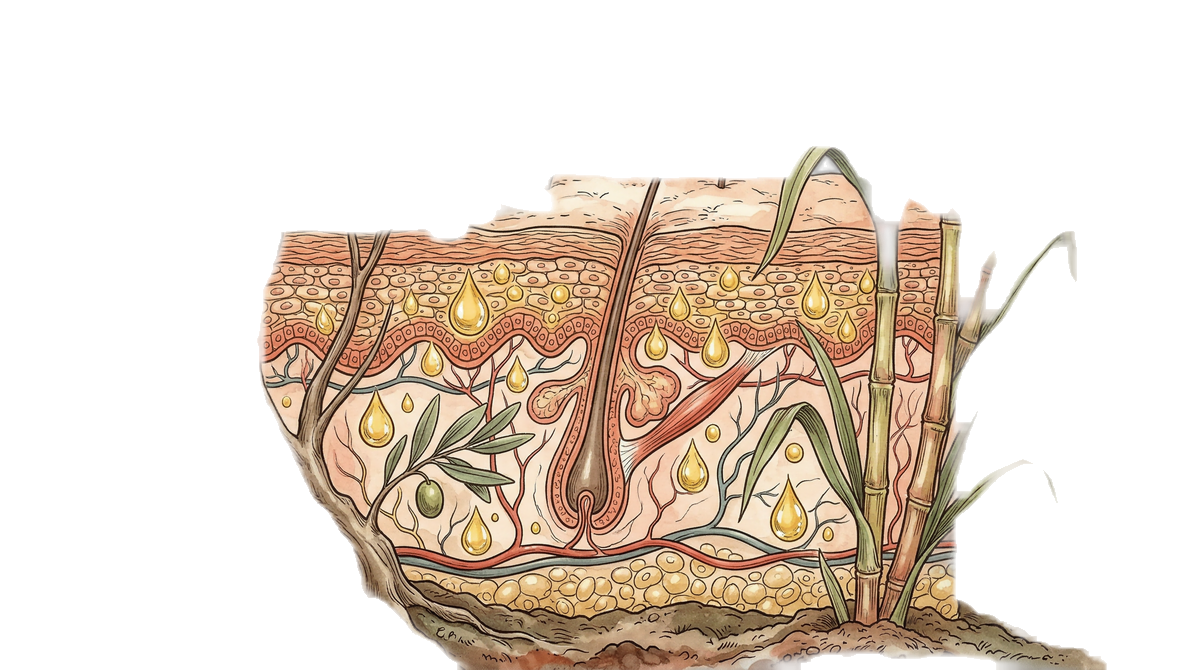
Your skin already makes squalane, or close enough to it. Your sebaceous glands produce squalene (with an 'e'), which makes up about 12% of your sebum. Hydrogenate it to saturate the double bonds and you get squalane: shelf-stable, non-comedogenic, and structurally close enough to your own skin lipids that it integrates into the intercellular matrix of the stratum corneum rather than sitting on top. At ~423 Da, it penetrates the upper epidermis and fills gaps between your corneocytes, reducing transepidermal water loss without the greasy film of petrolatum. That's why squalane works on oily skin without shine and on dry skin without heaviness: it slots into your barrier the way a native lipid would.
Your skin already makes this oil. It just stops making enough of it.
Mimics 12% of your skin's own sebum
Human sebaceous glands produce squalene, which makes up about 12% of sebum. Squalane is the hydrogenated, shelf-stable version, structurally close enough to integrate into the skin's lipid matrix rather than sitting on top.
Comedogenicity rating: 0-1 out of 5
One of the few oils that genuinely does not clog pores. At 423 Da, it penetrates the stratum corneum and fills gaps between corneocytes instead of forming a greasy surface film.
Improves delivery of lipophilic actives
Squalane disrupts lipid packing in the stratum corneum without causing irritation. Mixing it with retinol or vitamin E increases their penetration into the upper epidermis.
Clinical benefits
barrier support and moisture retention
Squalane reduced TEWL and increased stratum corneum hydration in a 4-week study of 20 subjects with dry skin. Its structural similarity to native skin lipids allows it to integrate into the barrier more effectively than plant oils with different fatty acid profiles.
Huang et al., 2009 — Journal of Cosmetic Dermatology
Non-comedogenic moisturization
Squalane has a comedogenicity rating of 0-1 on the 0-5 scale, meaning it does not clog pores in standard rabbit ear assays. Clinical use confirms this: squalane is well tolerated on oily, acne-prone skin when applied in thin layers.
Draelos, 2012 — Journal of Cosmetic Dermatology
Antioxidant protection
Squalene (the unsaturated precursor) is a potent lipid-soluble antioxidant in human skin, scavenging singlet oxygen generated by UV exposure. While squalane is less reactive than squalene due to hydrogenation, it still contributes to the lipid antioxidant pool in the stratum corneum.
Kohno et al., 1995 — Biochimica et Biophysica Acta
Improved absorption of other actives
Squalane acts as a penetration enhancer for lipophilic compounds. When mixed with retinol or vitamin E, squalane increases their delivery into the upper epidermis by disrupting lipid packing in the stratum corneum without causing irritation.
Pham et al., 2016 — International Journal of Pharmaceutics
Products with squalane
Paid links: Koracle may earn from qualifying purchases. Details.
Skin types
Every skin type benefits from squalane, which is unusual for an oil. If your skin runs oily or acne-prone, you'll tolerate it because it's non-comedogenic and absorbs fast: 2-3 drops patted into damp skin leave no oily residue. If your skin is dry, squalane reinforces your barrier, though you may want a heavier cream on top for full occlusion. Sensitive skin handles it well: it's a pure hydrocarbon with no fragrance, no active acids, and no protein components to trigger a reaction.
Effective concentrations
Serums, creams, and emulsions. Adds emollient and mild occlusive coverage.
2-4 drops mixed into moisturizer or applied after serum. Standalone use for oily skin; barrier-sealing layer for dry skin.
Pairs well with
Hyaluronic acid
HA pulls water into the epidermis; squalane seals it there with a lightweight lipid layer. Apply HA to damp skin first, then 2-3 drops of squalane on top. This gives both humectant and emollient coverage.
Retinol
Squalane buffers retinol irritation by reinforcing the lipid barrier and acts as a penetration enhancer that improves retinol delivery. Mixing a drop of squalane into your retinol product can reduce flaking during the adjustment period.
Ceramides
Squalane and ceramides address different lipid classes in the barrier: squalane replaces lost sebum components, ceramides replace structural lipids between corneocytes. Together they rebuild the full lipid barrier.
The bottom line
Squalane is the most versatile oil in skincare because it mimics what skin already produces. It repairs the barrier, does not clog pores, absorbs in minutes, and improves the delivery of lipophilic actives like retinol. Use it as a standalone moisturizer for oily skin (2-3 drops on damp skin) or as a barrier-sealing layer over heavier routines for dry skin. Plant-derived squalane from olives or sugarcane is chemically identical to shark-derived. Check the source if that matters to you.
Common questions
What is the difference between squalane and squalene?
Squalene (with an 'e') is the natural form produced by sebaceous glands. It has unsaturated double bonds that make it reactive: it oxidizes quickly when exposed to air, turning rancid and potentially comedogenic. Squalane (with an 'a') is squalene with hydrogen atoms added to saturate those bonds. This makes it shelf-stable, non-reactive, and cosmetically elegant. All squalane skincare products use the hydrogenated form.
Will squalane make oily skin greasier?
No. Squalane absorbs into the stratum corneum within minutes because it mimics skin's own lipids. It does not sit on the surface the way mineral oil or coconut oil does. Use 2 drops on damp skin. If you find any residual shine, you are likely using too much. Many people with oily skin use squalane as their only moisturizer, skipping heavier creams entirely.
Is plant-derived squalane better than shark-derived squalane?
Chemically, they are identical molecules. Once squalene is hydrogenated into squalane, the source is irrelevant to skin performance. The difference is ethical and environmental: deep-sea shark fishing for liver oil has conservation concerns. Most K-beauty brands now use olive-derived or sugarcane-derived squalane. Check the label or brand website if this matters to you.
Can I use squalane as my only moisturizer?
For oily and combination skin in humid climates, yes. Squalane provides emollient and mild occlusive coverage in a single step. For dry skin or dry climates, squalane alone may not be enough: it is a lightweight occlusive, not a heavy one. Layering it over a humectant serum (hyaluronic acid or snail mucin) and under a ceramide cream gives better results for dry skin types.
Does squalane expire or go bad?
Pure squalane is extremely stable because the hydrogenation removes reactive double bonds. It does not oxidize under normal storage conditions and has a shelf life of 2+ years unopened. Once opened, use within 12 months. If it develops an off smell or changes color, the product may contain other ingredients that degraded. Pure squalane itself should remain clear and odorless indefinitely under reasonable conditions.
Find products with Squalane matched to your skin.