
MLE Technology in K-Beauty: Biomimetic barrier support That Mirrors Your Skin
In this article
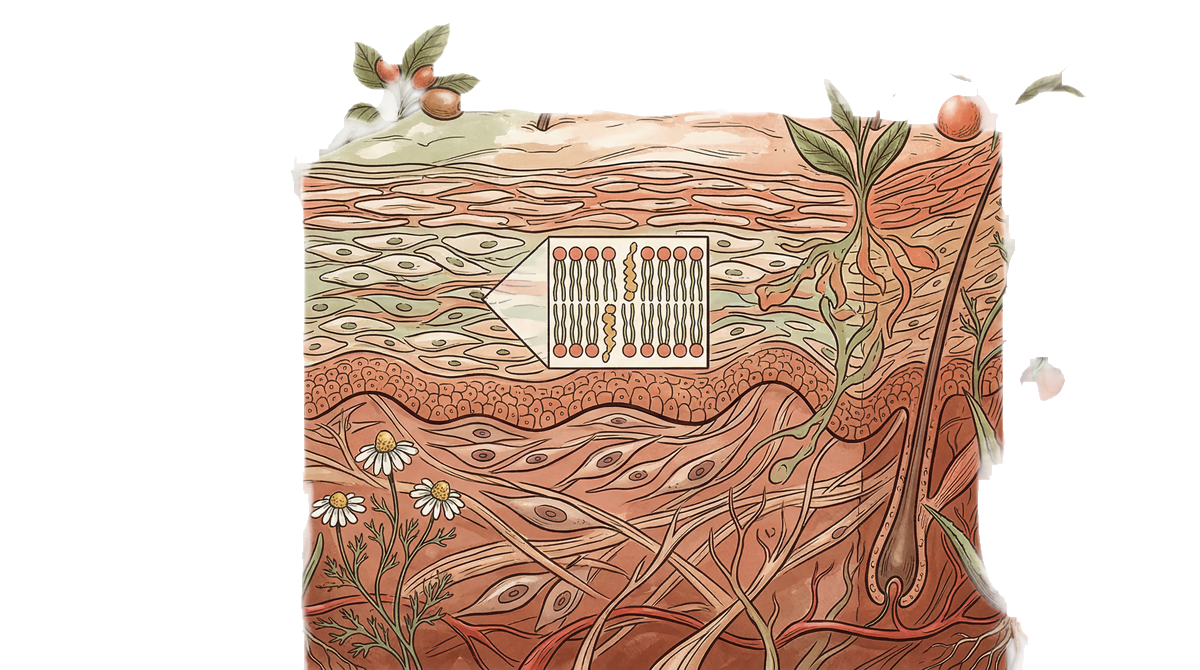
Your stratum corneum is not a simple oil layer. It is a stack of alternating lipid and water sheets (lamellar bilayers) made of ceramides, cholesterol, and free fatty acids in a roughly 3:1:1 molar ratio. Standard creams dump lipids onto the surface in random orientation. MLE (Multi-Lamellar Emulsion) technology arranges ceramides, cholesterol, and fatty acids into a lamellar structure that mirrors the stratum corneum's own organization. This matters because lipids in the wrong orientation do not integrate into the barrier properly. Park et al. (2003) in the British Journal of Dermatology showed that MLE cream restored barrier function (measured by TEWL) 60% faster than a conventional ceramide cream in SLS-damaged skin.
The difference between dumping lipids on your skin and actually rebuilding the barrier comes down to structure.
Lipids arranged in lamellar bilayers, not random droplets
MLE technology uses controlled processing to organize ceramides, cholesterol, and fatty acids into alternating lipid-water sheets that mimic the stratum corneum's natural lamellar structure.
60% faster barrier recovery than conventional ceramide cream
In SLS-disrupted skin, MLE cream reduced TEWL significantly faster than a standard ceramide emulsion with the same lipid composition but random orientation. Structure, not just composition, determines repair speed.
Integrates into existing lipid lamellae rather than sitting on top
Because the lipids are pre-organized in the correct orientation, they can insert directly into gaps in the stratum corneum's lamellar sheets. Random-orientation lipids must be reorganized by the skin, which takes longer.
Myth: Any cream with ceramides repairs the barrier the same way MLE does.
Reality: Ceramides in a conventional emulsion are randomly oriented within oil droplets. The stratum corneum's barrier function depends on ceramides being arranged in lamellar bilayers. Park et al. (2003) showed that identical ceramide concentrations in MLE format repaired barrier function 60% faster than the same ceramides in a standard cream. The structural organization of the lipids is what makes MLE different.
Clinical benefits
Faster barrier recovery in damaged skin
In a controlled study using SLS (sodium lauryl sulfate) to disrupt the skin barrier, MLE cream restored TEWL values to baseline 60% faster than a conventional ceramide cream with identical lipid composition. The difference was statistically significant at 24 hours post-application.
Park et al., 2003, British Journal of Dermatology
Sustained TEWL reduction
MLE cream maintained lower TEWL values for 12 hours after a single application, compared to 6 hours for conventional ceramide cream. The lamellar structure provides longer-lasting occlusion because it integrates rather than sitting on the surface.
Park et al., 2003, British Journal of Dermatology
Atopic dermatitis symptom improvement
A 4-week Korean clinical trial of MLE cream in 50 patients with mild-to-moderate atopic dermatitis showed 55% reduction in SCORAD index (severity scoring). TEWL decreased by 38% and stratum corneum hydration increased by 45%.
Ahn et al., 2006, Journal of Dermatological Treatment
Skin types
MLE is particularly suited to dry, sensitive, eczema-prone, and barrier-compromised skin. It is the targeted option for people recovering from over-exfoliation, retinoid irritation, or environmental barrier damage. Oily skin types may find MLE creams too rich for daytime use; apply at night as the last step. Combination skin can use it on dry zones only.
Effective concentrations
The lipid ratio (3:1:1 ceramide:cholesterol:fatty acid) matters more than total percentage. Look for products specifying 'MLE' or 'multi-lamellar emulsion' technology.
Pairs well with
Hyaluronic acid
HA pulls water into the epidermis; MLE seals it in with a biomimetic lipid barrier. Apply HA serum first, then MLE cream on top.
Centella asiatica
Centella supports firmer-looking skin and calms inflammation while MLE repairs the lipid barrier. Together they address both the structural protein matrix and the lipid barrier component of damaged skin.
Panthenol
Panthenol (provitamin B5) attracts water into the epidermis and reduces inflammation. MLE provides the lipid seal. The combination is a standard K-beauty protocol for severely dehydrated or irritated skin.
Avoid combining with
High-concentration AHA/BHA immediately before application
Strong acids dissolve the lipid lamellae that MLE is trying to rebuild. If using acids, wait 20-30 minutes before applying MLE cream so the acid has absorbed and pH has normalized.
The bottom line
MLE is the most scientifically precise approach to barrier support available in K-beauty. Instead of just adding ceramides, it arranges them in the same lamellar structure found in healthy skin. The clinical data from Park et al. shows this structural mimicry translates to faster barrier recovery. If your skin barrier is compromised (from over-exfoliation, retinoid use, eczema, or harsh weather), MLE products are the most targeted repair option. The downside: true MLE formulation is technically difficult, so only a few brands (primarily Atopalm/MLE) use the real technology.
Common questions
What is the difference between MLE cream and regular ceramide cream?
Both contain ceramides, cholesterol, and fatty acids. The difference is structural. In a regular cream, these lipids are randomly oriented within oil droplets. In MLE, they are organized into lamellar bilayers that mirror the stratum corneum's natural structure. This structural organization lets MLE lipids integrate directly into the skin's barrier, repairing it faster.
Which brands use real MLE technology?
Atopalm (by Neopharm, the Korean company that developed the technology) is the primary brand. Their MLE line includes creams, lotions, and cleansers. Some other Korean brands license or develop similar lamellar emulsion technology, but the term 'MLE' is most associated with Atopalm. Not every product that mentions 'lamellar' uses true multi-lamellar processing.
Can I use MLE cream if I have oily skin?
Yes, but apply it at night. MLE creams tend to be rich because the lamellar lipid structure requires a certain lipid concentration. During the day, a lighter ceramide serum may be more comfortable. At night, MLE cream provides intensive barrier support without the heaviness being a cosmetic issue.
How long does MLE take to repair a damaged barrier?
Clinical data shows significant TEWL improvement within 24 hours of application. Full barrier recovery from disruption (over-exfoliation, retinoid damage) takes 1-4 weeks of consistent use, depending on the severity of damage. MLE does not rebuild the barrier in one application; it speeds the natural support process.
Find products with MLE (Multi-Lamellar Emulsion) matched to your skin.