
EGF in Korean Skincare: The Growth Factor That Went From Wound Care to Anti-Aging
In this article
EGF won Stanley Cohen a Nobel Prize in 1986. His discovery that a 53-amino-acid peptide could trigger cell proliferation and migration opened an entire field of growth factor biology. Its first clinical application was wound care: burns, diabetic ulcers, surgical wounds. Korean pharmaceutical companies were among the first to take it cosmetic. Shin et al. (2006) at Seoul National University showed topical rhEGF at 1 ppm reduced wrinkle depth by 33% and increased epidermal thickness by 15% over 8 weeks. The science behind that result is solid. The legitimate question is penetration: EGF weighs 6.2 kDa, far above the 500 Da threshold for passive stratum corneum diffusion. The clinical data shows activity anyway, likely through hair follicles, micro-abrasions, and transfollicular transport. Post-procedure, when your barrier is temporarily disrupted, penetration is not a question at all.
A Nobel Prize-winning discovery that went from burn wards to beauty shelves. Does it actually work on intact skin?
Binds EGFR receptors to trigger keratinocyte proliferation
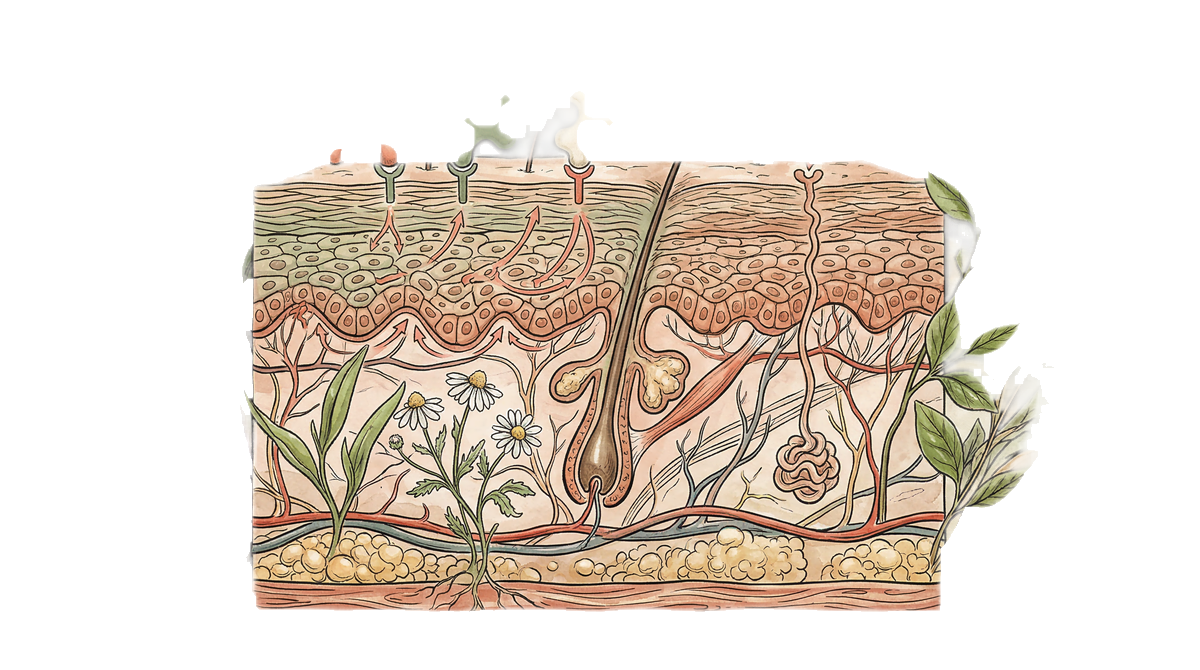
EGF activates the EGFR (ErbB1) tyrosine kinase receptor, which triggers the Ras/MAPK and PI3K/Akt signaling cascades. These promote keratinocyte and fibroblast division, migration, and ECM protein synthesis.
33% wrinkle reduction in a Korean clinical trial (1 ppm, 8 weeks)
Shin et al. applied 1 ppm recombinant human EGF cream to periorbital wrinkles in 30 subjects. Profilometry showed 33% reduction in wrinkle depth and improved skin texture. Histology confirmed 15% thicker epidermis.
6.2 kDa molecular weight: too large for passive penetration, but still shows activity
The 500 Da rule suggests EGF cannot passively cross intact stratum corneum. Yet clinical studies show measurable effects, likely due to penetration through hair follicles, micro-abrasions, and transfollicular transport. Post-procedure application (after microneedling or laser) bypasses the barrier entirely.
Myth: EGF in skincare could promote skin cancer because it stimulates cell growth.
Reality: This concern is theoretically reasonable but clinically unfounded. EGF stimulates proliferation of normal keratinocytes and fibroblasts through regulated EGFR signaling. Topical EGF at cosmetic concentrations has not been linked to increased skin cancer risk in any published study. EGFR mutations in cancer involve constitutive (always-on) receptor activation, which is a different mechanism from transient ligand binding. No dermatology regulatory body has flagged topical EGF as a cancer risk.
Clinical benefits
Reduces wrinkle depth and improves skin texture
A randomized controlled trial of 30 subjects applied 1 ppm rhEGF cream to one side of the face (periorbital area) and vehicle to the other for 8 weeks. Profilometry showed 33% reduction in wrinkle depth on the EGF side. Histological analysis confirmed 15% increased epidermal thickness.
Shin et al., 2006 — Journal of Dermatological Treatment
Accelerates skin recovery and re-epithelialization
Topical rhEGF at 10 ppm accelerated re-epithelialization of partial-thickness wounds by 30% in a controlled trial of 40 patients. Complete recovery occurred at 7.2 days (EGF) vs. 10.1 days (vehicle). EGF's wound-recovery application is its most robustly validated use.
Hong et al., 2006 — Journal of Pharmacology and Experimental Therapeutics
Increases epidermal renewal and thickness
Topical EGF stimulates basal keratinocyte proliferation, increasing the rate of epidermal turnover. Histological measurements in the Shin et al. trial showed 15% thicker epidermis after 8 weeks. Thicker epidermis improves light scattering (more glow), reduces TEWL, and is more resilient to mechanical stress.
Shin et al., 2006 — Journal of Dermatological Treatment
Products with egf
Paid links: Koracle may earn from qualifying purchases. Details.
Skin types
EGF works through receptor binding on keratinocytes, which is independent of skin type, so all skin types can use it. Your best-case scenarios are aging skin (reduced epidermal turnover), post-procedure skin (compromised barrier, direct access to basal cells), and sun-damaged skin (thinned epidermis that needs renewal). If you are acne-prone, worth noting: increased keratinocyte proliferation could theoretically worsen comedone formation. That has not been documented in clinical studies, but it is a mechanism worth watching if you start breaking out after introducing EGF.
Effective concentrations
The concentration used in the Shin et al. trial. EGF is potent at very low doses because it works through receptor binding, not bulk chemistry.
Some Korean medical-grade products use higher concentrations. Diminishing returns above 10 ppm, as receptor saturation limits additional benefit.
Pairs well with
Peptides (copper peptide, palmitoyl tripeptide)
Other signaling peptides activate fibroblasts through different receptors. EGF (EGFR) + copper peptide (TGF-beta, VEGF) provide multi-pathway collagen stimulation.
Hyaluronic Acid
HA provides the hydration that newly proliferating keratinocytes need. EGF increases cell turnover; HA supports the hydration of the new cells.
Centella Asiatica
Centella promotes skin recovery via TGF-beta, a different pathway from EGF's EGFR. The combination accelerates post-procedure recovery.
Avoid combining with
No established conflicts
EGF works through receptor binding and has no pH-dependent activity. It is compatible with acids, retinoids, and vitamin C in formulation. Some formulators avoid combining EGF with high-concentration AHAs due to potential peptide degradation at very low pH, but this is a stability concern, not a skin interaction.
The bottom line
EGF has a strong mechanism and clinical evidence from Korean dermatology research showing measurable anti-aging benefits. The penetration question is valid: at 6.2 kDa, EGF is larger than the 500 Da rule for passive stratum corneum penetration. However, the Shin et al. data shows biological activity from topical application, suggesting some EGF reaches viable cells through hair follicles, micro-disruptions, or active transport. Korean brands use delivery technologies (liposomes, nanoparticles) to improve penetration. EGF is most effective on compromised or recently treated skin (post-laser, post-microneedling) where the barrier is temporarily disrupted and EGFR access is direct.
Common questions
Can EGF penetrate intact skin?
At 6.2 kDa, EGF is too large for passive diffusion through intact stratum corneum (the 500 Da rule). Clinical studies showing activity on intact skin suggest penetration through hair follicles, intercellular spaces, or micro-disruptions in the barrier. Post-procedure application (after microneedling, laser, or chemical peels) bypasses this problem entirely, which is why many dermatologists recommend EGF specifically for post-treatment recovery.
Does EGF cause cancer?
No published study has linked topical EGF at cosmetic concentrations to skin cancer. EGFR mutations in cancer involve constitutive receptor activation (the receptor is stuck in the 'on' position). Topical EGF provides transient ligand-mediated activation that the cell regulates normally. This is a frequently asked question, and the answer from the dermatology community is consistent: topical EGF at cosmetic doses is safe.
Where does the EGF in skincare come from?
Skincare EGF is recombinant human EGF (rhEGF), produced by genetically engineered bacteria (E. coli) or yeast (Saccharomyces cerevisiae) carrying the human EGF gene. It is identical to the EGF your body naturally produces. It is not extracted from animals or human tissue.
Find products with EGF matched to your skin.