
Bee Venom for Anti-Aging: How It Works
In this article
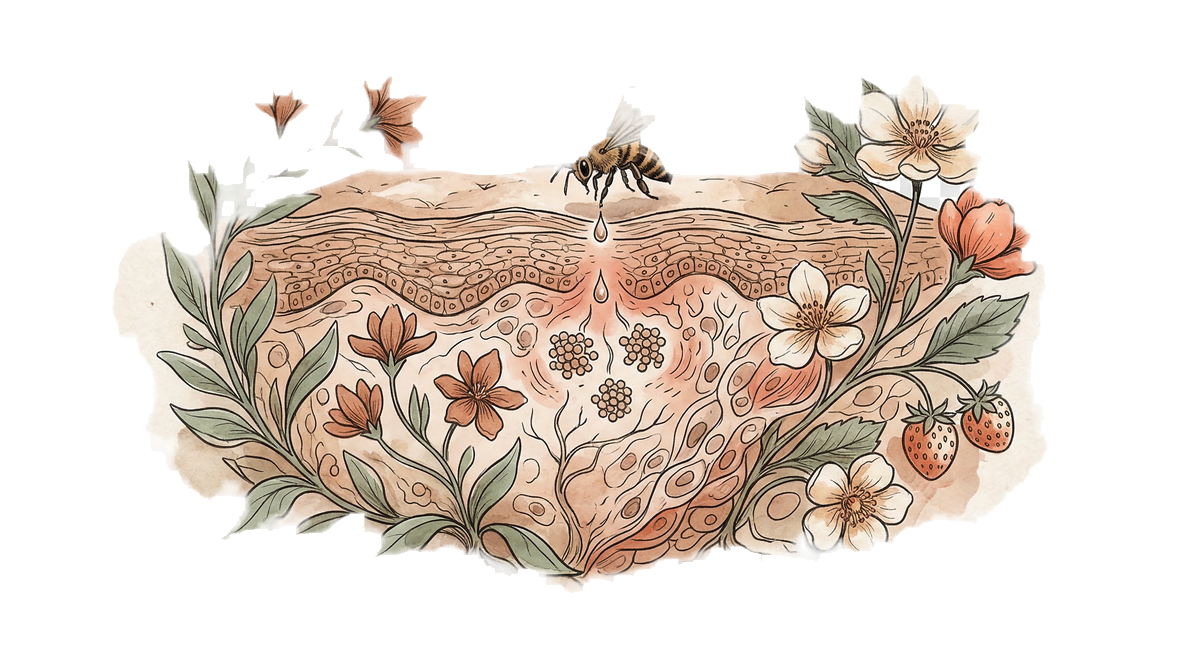
Bee venom works by tricking your skin into thinking it has been stung. Not hard enough to cause real damage, just enough to trigger the recovery response. Melittin, a 26-amino-acid peptide that makes up 50% of dry bee venom, inserts into cell membranes and activates phospholipase A2. Your skin responds with increased blood flow, fibroblast recruitment, and upregulated firmer-looking skin support via the TGF-beta pathway. Then the inflammation resolves, and what remains is the collagen. Han et al. (2015) at Kyung Hee University ran a placebo-controlled trial: bee venom serum reduced total wrinkle count by 57% and wrinkle depth by 38% over 12 weeks. The mechanism is real, the data is solid, and the risk is also real. If you have any history of bee-related allergy, this is not an ingredient to explore.
A tiny dose of venom tricks your skin into thinking it's been stung. The recovery response builds collagen.
Melittin triggers controlled micro-inflammation that supports firmer-looking skin
Melittin inserts into cell membranes and activates PLA2 (phospholipase A2), which starts a localized inflammatory cascade. At cosmetic doses (0.001-0.01%), this cascade is mild enough to trigger firmer-looking skin support without causing visible inflammation.
57% fewer wrinkles in a 12-week Korean clinical trial
Han et al. tested bee venom serum vs. placebo in 22 women aged 30-49. The bee venom group showed statistically significant improvements in wrinkle count (57%), wrinkle depth (38%), and UV spot count. No serious adverse events.
Apamin in the venom may relax facial muscles (mild botox-like effect)
Apamin is an 18-amino-acid neurotoxin in bee venom that blocks SK channels (small conductance calcium-activated potassium channels). At cosmetic concentrations, this may produce a mild muscle-relaxing effect. The evidence for topical apamin reaching facial muscles is preliminary.
Myth: Bee venom skincare is just a marketing gimmick with no real mechanism.
Reality: The mechanism is well-characterized: melittin activates PLA2, triggering a controlled inflammatory cascade that upregulates firmer-looking skin support through the TGF-beta pathway. Han et al. (2015) demonstrated measurable wrinkle reduction in a placebo-controlled trial. The science is real, but so is the allergy risk. This is not a gimmick ingredient, but it is one that requires caution.
Clinical benefits
Wrinkle reduction through collagen stimulation
A randomized, double-blind, placebo-controlled trial of 22 women (aged 30-49) applied bee venom serum to one side of the face and placebo to the other for 12 weeks. The bee venom side showed 57% reduction in total wrinkle count and 38% reduction in average wrinkle depth, measured by Visia-CR imaging.
Han et al., 2015 — Clinical Interventions in Aging
Increased collagen and elastin synthesis in vitro
Human dermal fibroblasts treated with purified bee venom at 1 mcg/mL showed 2.1-fold increase in type I procollagen mRNA and 1.8-fold increase in elastin mRNA after 48 hours. The upregulation was mediated through TGF-beta and MAPK/ERK pathways.
Han et al., 2013 — Toxicology and Applied Pharmacology
Anti-inflammatory at low doses (paradoxical effect)
While melittin is pro-inflammatory at high concentrations, at 0.1-1 mcg/mL it inhibits NF-kB and reduces TNF-alpha, IL-1beta, and IL-6 expression in activated macrophages. This biphasic dose-response (hormesis) explains how bee venom can simultaneously trigger firmer-looking skin support and reduce chronic inflammation.
Son et al., 2007 — Journal of Pharmacology and Experimental Therapeutics
Products with bee venom
Paid links: Koracle may earn from qualifying purchases. Details.
Skin types
If you have no bee allergy history and your skin is not chronically reactive, bee venom is worth trying. Oily, dry, and combination skin all tolerate it at cosmetic concentrations. Sensitive skin should skip it: the entire mechanism depends on triggering an inflammatory response, which is the last thing reactive skin needs. If you have any history of bee sting allergy, anaphylaxis, or insect venom sensitivity, do not use bee venom products at any concentration. For everyone else: apply a small amount to your inner forearm and wait 48 hours before going near your face.
Effective concentrations
Most K-beauty bee venom products (creams, serums). Enough to trigger mild collagen response without visible redness.
Upper end of cosmetic use. May cause mild tingling. Patch test is mandatory at this concentration.
Pairs well with
Adenosine
Adenosine is an approved anti-wrinkle active in Korean cosmetics regulation. It supports firmer-looking skin through a different pathway (adenosine receptor-mediated), complementing bee venom's inflammation-mediated collagen stimulation.
Peptides
Signal peptides (palmitoyl tripeptide, copper peptide) stimulate fibroblast activity through receptor-mediated pathways. Combined with bee venom's TGF-beta stimulation, you get multiple collagen activation signals.
Snail Mucin
Snail mucin's glycoprotein matrix soothes the micro-inflammation from bee venom while supporting the wound-recovery cascade. This is a classic K-beauty pairing.
Avoid combining with
Strong AHAs or retinol on the same night
Bee venom relies on a controlled inflammatory response. Adding another irritant (AHA, retinol) on top can push the inflammation past the beneficial range into genuine irritation. Alternate nights.
Other bee products (if allergic)
Cross-reactivity between bee venom, propolis, and royal jelly is possible. If you react to any bee product, avoid all of them.
The bottom line
Bee venom is one of the more interesting anti-aging ingredients in K-beauty, backed by a well-designed Korean clinical trial showing significant wrinkle reduction. The mechanism (controlled micro-inflammation leading to collagen upregulation) is biologically plausible and supported by the data. The risk is real allergy: melittin can trigger anaphylaxis in venom-sensitive individuals. Always patch test. If you tolerate it, bee venom offers a unique approach to collagen stimulation that works through a different pathway than retinol, vitamin C, or peptides. If you have any history of bee-related allergies, skip it entirely.
Common questions
Do bees die to make bee venom skincare?
Most Korean bee venom suppliers use electrical stimulation: a glass plate with a mild electric current is placed at the hive entrance. Bees sting the glass, deposit venom, and fly away unharmed. The venom dries on the glass and is collected. No bees are killed in this process.
How do I know if I'm allergic to bee venom skincare?
Apply a small amount to your inner forearm and wait 48 hours. Redness, swelling, itching, or hives indicate a reaction. If you have a known bee sting allergy, do not test bee venom products at all. Anaphylaxis risk exists even at cosmetic concentrations for venom-sensitive individuals.
Is bee venom safe during pregnancy?
There are no studies on topical bee venom use during pregnancy. Given the inflammatory mechanism and the theoretical risk of immune activation, most dermatologists recommend avoiding bee venom products during pregnancy. There are safer alternatives for anti-aging during pregnancy (bakuchiol, vitamin C, peptides).
Find products with Bee Venom matched to your skin.