
Anua Heartleaf Toner: What Heartleaf Actually Does for Redness
In this article
You've seen the videos: a red, irritated cheek on the left, a calm one on the right, and a green bottle of Anua Heartleaf 77% Soothing Toner in the middle. The claim is that heartleaf (also called Houttuynia cordata) calms redness within minutes. The product sells out on this promise.
Your skin is not confusing. The marketing around heartleaf is.
TL;DR
Heartleaf has real anti-inflammatory activity in lab studies, but most of the visible "calming" from a heartleaf toner comes from the hydration, not the herb. Use it as a gentle layer, not a redness fix.
What the heartleaf claim leaves out
The TikTok claim treats heartleaf like a topical antihistamine. Apply it, wait, watch redness drop. That's not what the research describes.
Most heartleaf data lives in cell culture and mouse models. Studies on Houttuynia cordata extract show it suppresses inflammatory cytokines like TNF-α and IL-6 and inhibits the NF-κB pathway (Chun et al., 2014; Shingnaisui et al., 2018). Those are real findings. They are also indirect: they tell you the molecule can dampen inflammation in a dish, not that a 77% aqueous extract patted into your skin will resolve a flare in five minutes.
What's missing from the claim: dose, depth, and time. The studies use concentrated extracts on isolated cells. A toner has to penetrate the stratum corneum, hit live inflammatory cells, and do so at a concentration high enough to matter. We don't have a controlled clinical trial showing that happens.
Most of the visible "calming" from a heartleaf toner is the hydration and the cool-pat sensation. The herb is a slow background signal, not a switch.
How heartleaf actually works on inflamed skin
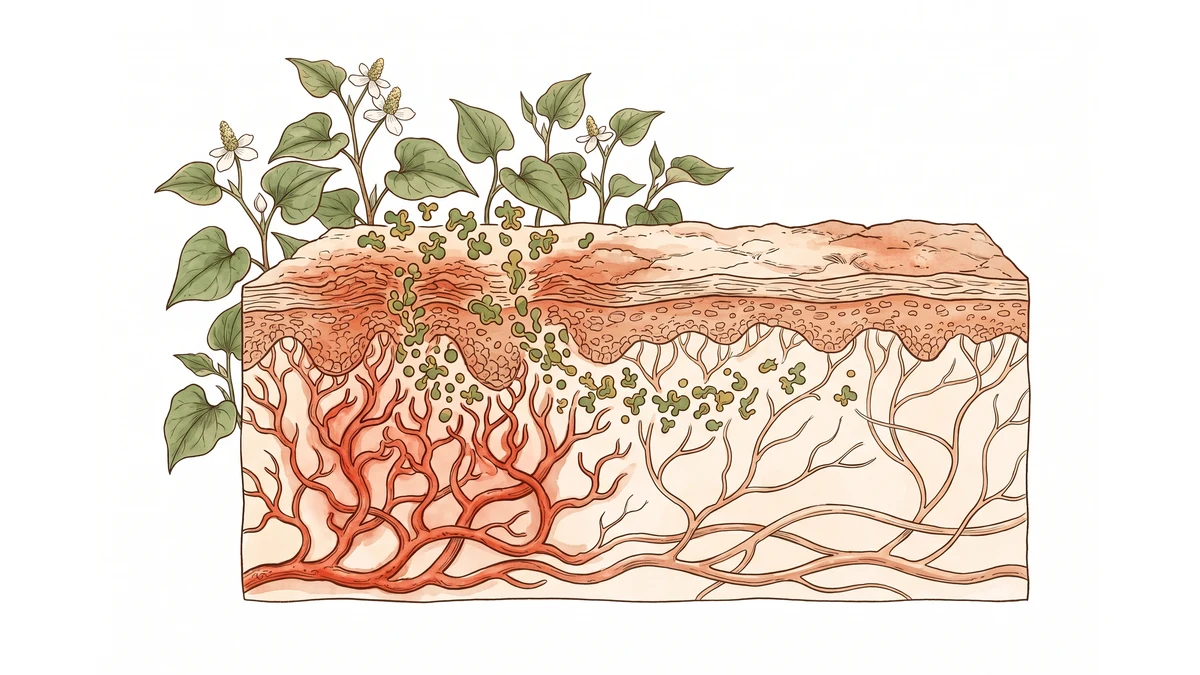
Heartleaf's main bioactives are quercitrin, hyperoside, and chlorogenic acid. These are polyphenols, the same family as the antioxidants in green tea. They scavenge reactive oxygen species and interfere with the signaling cascade that turns "your skin sensed something irritating" into "your skin is now red and swollen."
In plain English: when your skin gets triggered by friction, UV, or a harsh actives layer, immune cells release inflammatory messengers. Heartleaf polyphenols can quiet some of those messengers. The effect is mild, gradual, and best understood as reducing the size of small flare-ups over weeks, not erasing a visible flush in real time.
This is also why heartleaf shows up alongside centella in so many K-beauty formulas. They work on overlapping pathways but through different molecules.
The "77%" on the Anua label refers to the percentage of heartleaf-derived water in the formula, not the concentration of active extract. That number is doing marketing work, not pharmacology work.
What the toner format is actually doing
The bottle is helping your skin, just not for the reason on the label. A watery toner delivers hydration, glycerin or butylene glycol as humectants, and a low-friction application. Patting cool liquid onto warm, irritated skin reduces transepidermal water loss and feels physically calming. That sensation is real and measurable.
If you peeled off the heartleaf label and replaced it with "hydrating essence toner," you'd still get most of the same surface result on day one. The heartleaf is doing background work: slow polyphenol activity, mild antioxidant support, and a low risk of irritation because the extract itself is bland.
This is good news. It means the toner is genuinely safe to layer, and it pairs well with stronger actives without conflict. It also means you shouldn't expect it to replace a real redness treatment.
Not sure if heartleaf is the right layer for your redness?
Answer 9 questions. Koracle checks fit, conflicts, texture, and evidence.
Build my routine →When heartleaf is the right pick (and when it isn't)
Pick heartleaf if your redness is mild, situational, and tied to dryness. Examples: post-cleanse flush, low-grade reactive skin, the morning after a stronger exfoliant. The toner format is a buffer between cleansing and your treatment steps, and the polyphenols quietly support the barrier work your moisturizer is doing.
Skip heartleaf as your main fix if you have rosacea, persistent capillary flush, or perioral dermatitis. Those need:
- Azelaic acid 10–15% for inflammatory redness and rosacea papules
- Centella-based barrier creams with clinical data for sensitive, compromised skin
- A dermatologist if redness persists more than a few weeks
Paid links: Koracle may earn from qualifying purchases. Details.
View on Amazon. Amazon shows final price and availability.
For pairing with a calming routine, a centella or panthenol moisturizer does more visible work than the toner on its own. The toner sets up the skin; the cream seals it in.
Paid links: Koracle may earn from qualifying purchases. Details.
View on Amazon. Amazon shows final price and availability.
Paid links: Koracle may earn from qualifying purchases. Details.
View on Amazon. Amazon shows final price and availability.
The bottom line
Anua Heartleaf Toner is a well-formulated, low-irritation hydrating layer with a mild background anti-inflammatory effect. It is not a redness eraser, and the "77%" number is marketing, not active concentration. Use it as the gentle first step in a calming routine, and put your real redness budget into azelaic acid or a centella-led barrier cream.
Common Questions
Does heartleaf actually reduce redness on the same day?↓
The visible calming you see in TikTok reviews is mostly the toner format, not heartleaf-specific anti-inflammatory action. Real redness reduction from Houttuynia cordata is a slow signal, measured over weeks in cell and animal studies, not in five minutes.
Is Anua Heartleaf Toner enough for rosacea or persistent flushing?↓
No. Heartleaf has mild anti-inflammatory activity in lab studies, but rosacea-grade redness needs azelaic acid, ivermectin, or a prescription topical. Heartleaf can sit alongside those as a low-irritation supporting layer.
Heartleaf or centella for sensitive skin?↓
Centella has stronger clinical evidence in humans for barrier repair and redness. Heartleaf has more lab data than clinical data. If you only pick one for visible results, centella is the safer bet.
Can I use heartleaf toner with retinol or actives?↓
Yes. There's no known conflict, and the toner is mostly water and humectants. Use heartleaf first as a buffer layer, then your active, then a barrier cream on top.
Turn what you learned into a routine that fits your skin.
Answer a few questions and Koracle will check formula fit, budget, tolerance, and routine order.
Build my formula-checked routine